Shuicheng North Panjiang Bridge
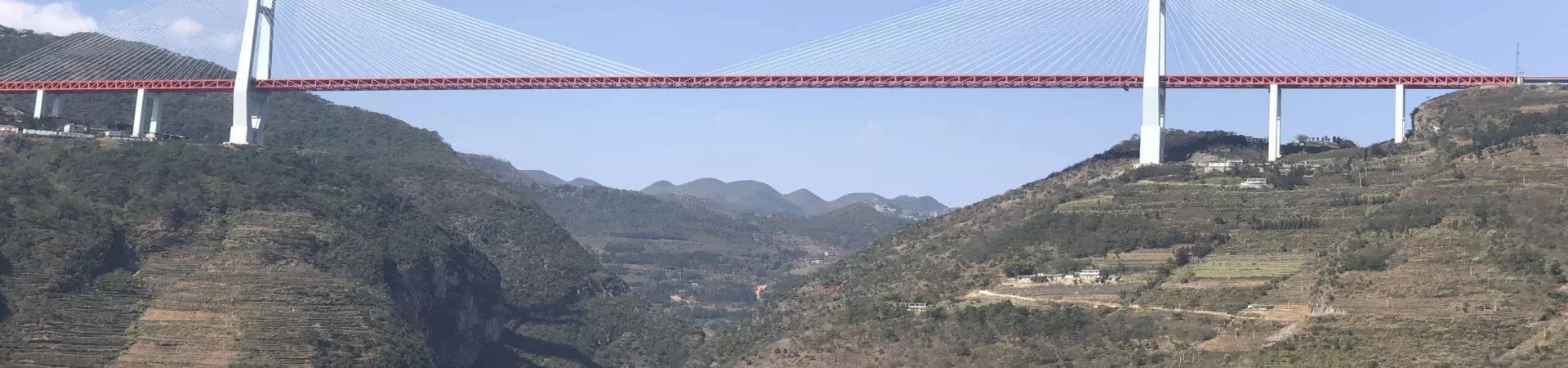
Subtitle: Spanning the Depths: A Journey Across the Beipanjiang First Bridge
1. Introduction: A Colossus in the Clouds
Nestled amidst the rugged, mountainous terrain separating the provinces of Yunnan and Guizhou in southwestern China, an engineering marvel silently performs its daily duty. This is the Beipanjiang First Bridge, a structure so vast and so precisely placed that it seems to defy both gravity and geography. Originally known as the Nizhu River Bridge or simply the Beipanjiang Bridge, this mega-arch bridge serves as a critical link in China's expansive national highway network, specifically forming an integral part of the Hangzhou-Ruili Expressway (G56). Its location is remote, connecting Xuanwei City's Puli Township in Yunnan with Shuicheng District's Duge Town in Liupanshui, Guizhou. However, its significance is global, having once held the undisputed title of the world's highest bridge, with its deck soaring an astonishing 565 meters (1,854 feet) above the Beipanjiang River (historically known as the Nizhu River at this gorge). It is not merely a transit route but a destination in itself, a testament to human ambition and a viewpoint offering some of the most breathtaking vistas in China.
2. Engineering and Architectural Grandeur
2.1. Design and Construction: A Feat of Precision The construction of the Beipanjiang First Bridge was a monumental challenge dictated by the extreme environment. The deep, sheer-sided gorge made traditional bridge-building techniques impossible. Engineers opted for a steel truss girder arch design, chosen for its superior strength-to-weight ratio and ability to span great distances without intermediate supports. The arch span itself stretches 720 meters (2,360 feet). The most groundbreaking aspect of the construction was the method: the majority of the structure was built using a cable-stayed cantilever method from both sides of the canyon, with sections meticulously lifted and assembled piece by piece. This process required millimeter-perfect precision, as the two halves of the arch had to meet perfectly in the middle, high above the river. The use of advanced materials, including high-strength steel and specialized concrete, ensured the bridge could withstand powerful winds, seismic activity, and its own immense load.
2.2. A Record-Holding Structure Upon its completion in 2016, the bridge instantly captured the world's attention by claiming the record for the highest bridge in the world, measured from the deck level to the surface of the water or ground below. This record highlighted not just its vertical scale but the sheer audacity of the project. While other bridges have since been built with taller piers, the Beipanjiang First Bridge remains an iconic symbol of this era of mega-engineering in China. Its record-breaking status transformed it from a local infrastructure project into an international landmark, attracting engineers, architects, and tourists from across the globe who come to witness its staggering scale firsthand.
3. The Visitor Experience
3.1. Practical Information for Travelers For those planning a visit, the bridge is remarkably accessible. As a vital part of a public highway, there is no admission fee to cross it. It is open to standard vehicular traffic 24 hours a day, 7 days a week, year-round. The most common way to experience it is by driving across. The journey offers a surreal experience as you leave the solid ground of one mountain, traverse the vast, open space of the gorge, and land on the opposite side. For safety and traffic flow, stopping on the bridge itself is strictly prohibited. The best visual experiences, therefore, are from within a moving vehicle or from designated observation areas.
3.2. Perspectives and Photography The true awe of the bridge is best appreciated from a distance. On the Guizhou (north) side of the gorge, a dedicated scenic overlook and parking area has been established. This viewpoint provides the classic, postcard-perfect panorama of the entire bridge set against the dramatic backdrop of the winding river and layered mountains. It is the ideal spot for photographers, especially at sunrise or sunset when the light paints the steel structure in warm hues and casts long shadows across the deep canyon. The perspective from below, though harder to access, is equally humbling, emphasizing the bridge's incredible height as it arcs gracefully between the two cliffs.
4. Context and Significance
4.1. A Catalyst for Regional Development Beyond its technical and touristic appeal, the Beipanjiang First Bridge serves a profound economic and social purpose. Before its existence, travel between the communities of Yunnan and Guizhou in this region was a long, arduous, and dangerous journey along winding mountain roads. The bridge reduced a multi-hour trip to a matter of minutes, dramatically improving connectivity. It has facilitated the movement of goods, boosted tourism for both provinces, and provided local residents with reliable, all-weather access to markets, healthcare, and opportunities. It stands as a concrete symbol of development and integration for some of China's more remote and challenging landscapes.
4.2. A Symbol in the Landscape The bridge does more than connect two points on a map; it connects people to a new perception of the possible. It represents a harmonious, though bold, intervention in a pristine natural setting. While some may see a contrast between nature and human creation, others see a form of modern artistry—a sleek, linear form juxtaposed against the chaotic beauty of the karst topography. It has become an inseparable part of the local identity, a source of pride for the residents of both Yunnan and Guizhou. For the visitor, it offers a moment of profound reflection on human ingenuity, the relentless pursuit of progress, and the breathtaking scale of China's natural world, all framed within the span of a single, unforgettable structure.