Oriental Buddhist Capital
Subtitle: A Modern Pilgrimage to Ancient Art: Exploring Leshan's Oriental Buddha Capital
1. Introduction: A Sacred Neighbor in a World Heritage Landscape Nestled within the same sacred range of Lingyun's Nine Peaks as the colossal Leshan Giant Buddha, the Oriental Buddha Capital (Dongfang Fodu) stands as a remarkable 4A-rated national tourist attraction. It resides within the boundaries of the UNESCO World Heritage site that encompasses the Giant Buddha, sharing its profound historical and spiritual ambiance. Spanning nearly a thousand acres of forested land, this site is not merely a park but a deliberate and artistic revival of lost Buddhist heritage. It occupies four of the legendary nine peaks, where during the Tang Dynasty, each peak was crowned with its own temple, all tragically lost to the wars of the Yuan Dynasty. Today, the Oriental Buddha Capital rises from the echoes of history, meticulously reconstructed to follow ancient traces while preserving the pristine, forested Tang-era mountain landscape. It is a realm where art, faith, and nature intertwine, offering a journey through millennia of Buddhist culture expressed in stone.
2. The Artistic and Spiritual Core: A Forest of Ten Thousand Buddhas The defining feature of the Oriental Buddha Capital is its breathtaking collection of Buddhist statuary, estimated to exceed ten thousand figures in total. These are not isolated exhibits but an integrated part of the mountain's fabric.
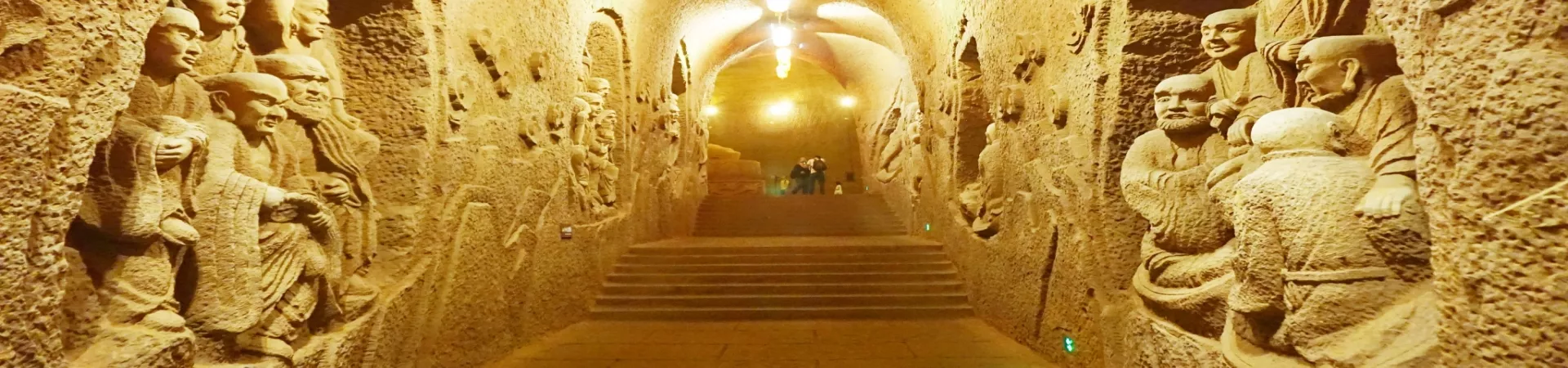
2.1. The Majesty of Cliff Carvings The primary artistic medium here is摩崖石刻 (moya shike), or cliff-side rock carving, a traditional Chinese technique where sculptures are hewn directly into natural rock faces. The artists and architects of this modern site have masterfully employed the principle of "following the mountain's contours" (依山取势). This means the statues are not placed arbitrarily but are designed in harmony with the cliffs, ridges, and slopes, creating a dynamic, organic tableau where the sculptures appear to emerge from the earth itself. The result is a powerful visual narrative that feels both ancient and timeless.
2.2. Iconic Highlights and Layout The most awe-inspiring masterpiece is the 170-meter-long Reclining Buddha, recognized as the world's largest of its kind. This monumental figure, depicting the Buddha's entry into Parinirvana, is a centerpiece that embodies the scale and ambition of the entire project. Beyond this giant, the landscape unfolds with the philosophy of "forests hiding a thousand Buddhas, and caves holding a hundred grottoes" (林隐千佛、洞中百窟). Life-sized and larger-than-life statues of Buddhas, Bodhisattvas, and disciples are strategically positioned among dense groves and along winding paths, inviting discovery around every corner. Numerous artificial and natural caves have been transformed into grotto shrines, housing intricate assemblies of figures, reminiscent of famous historical sites like the Mogao Caves or Dazu Rock Carvings, but on a newly conceived scale.
2.3. A Bridge Across Time This vast ensemble serves a dual purpose. Firstly, it vividly showcases the enduring spiritual essence and artistic styles of Chinese Buddhist culture across centuries. Secondly, and crucially, it stands as a testament to the skill of contemporary artisans. The Oriental Buddha Capital is a living project of cultural传承 (inheritance), proving that the ancient techniques of stone carving and the profound symbolic language of Buddhist art are not lost but are being actively continued and adapted by modern hands.
3. Essential Visitor Information 3.1. Location and Transportation The Oriental Buddha Capital is seamlessly integrated into the Leshan Giant Buddha scenic area complex. It is situated among the cluster of peaks, described poetically as being "separated from the Leshan Giant Buddha by only a single wall," indicating extremely close proximity, allowing for a convenient combined visit. * By Public Bus: From downtown Leshan, tourists can take bus routes 3 or 13, which provide direct service to the scenic area. * By Car: * From Chengdu: Take the Cheng-Ya Expressway via Xinjin, Pengshan, Meishan, Jiajiang to Leshan. After crossing the Minjiang River Bridge No. 1 or No. 2, follow signs to the Oriental Buddha Capital. * From Chongqing: Take the Cheng-Yu Expressway via Zigong and Yibin to Leshan city. Proceed to cross the Minjiang River Bridge No. 1 or No. 2 to reach the site.
3.2. Tickets and Opening Hours * Ticket Price: A full adult ticket is priced at 80 RMB. Discounted tickets (typically for students, seniors, etc.) are available for 50 RMB. These prices are valid year-round. * Operating Hours: The site is open daily from 8:00 AM to 5:00 PM. The last admission is at 5:00 PM.
3.3. Suggested Visit Duration A thorough exploration to appreciate the scale and detail of the sculptures requires approximately 1 to 3 hours. This allows for a leisurely pace to walk the paths, explore the grottoes, and contemplate the major works like the Reclining Buddha.
4. The Integrated Experience: Nature, History, and Art A visit to the Oriental Buddha Capital is more than a sightseeing tour; it is an immersive experience. The carefully preserved Tang-era山林风貌 (mountain forest scenery) provides a serene and authentic backdrop. The winding trails, the dappled light filtering through trees onto stone faces, and the quiet atmosphere away from the most crowded spots near the Giant Buddha create a contemplative environment. It functions as both an outdoor museum of religious art and a sacred space that continues the area's age-old function as a center for Buddhist reverence. It complements the historical authenticity of the Leshan Giant Buddha by presenting a conscious, modern continuation of the same artistic and devotional traditions, making the trip to Leshan a comprehensive encounter with Buddhist stone sculpture from its ancient roots to its contemporary expressions.