Fuliang Ancient County Yamen
Subtitle: A Journey Through Time in China's Porcelain Capital
1. An Imperial Legacy in Jiangnan: The Ancient County Yamen of Fuliang
Nestled within the historic heart of China's famed porcelain capital, Jingdezhen, lies a remarkable portal to the past: the Fuliang Ancient County Government complex. This site, encompassing the exceptionally preserved Qing Dynasty Yamen and the iconic Red Pagoda, is not merely a collection of old buildings but the enduring soul of the ancient Fuliang county, with a history stretching back to its founding in 817 AD during the Tang Dynasty. For over a millennium, this was the administrative and cultural nucleus of a region whose name became synonymous with the world's finest ceramics. Today, it offers visitors an unparalleled, immersive encounter with the tangible realities of late imperial Chinese local governance, architecture, and daily life.
2. The Architectural Marvel: "The First Yamen South of the Yangtze"
2.1. Layout and Grandeur The Fuliang Ancient County Yamen stands as the only fully intact county-level government office complex from the Qing Dynasty surviving in the Jiangnan region, rightfully earning its honorific title, "The First Yamen South of the Yangtze." The compound meticulously retains its original axial layout and traditional architectural hierarchy. Visitors progress through a sequence of gates and halls that mirror the ascending order of authority and ceremony: from the imposing Head Gate (Toumen) and the ceremonial Gate (Yimen), into the administrative courtyards, and onwards to the core halls of power.
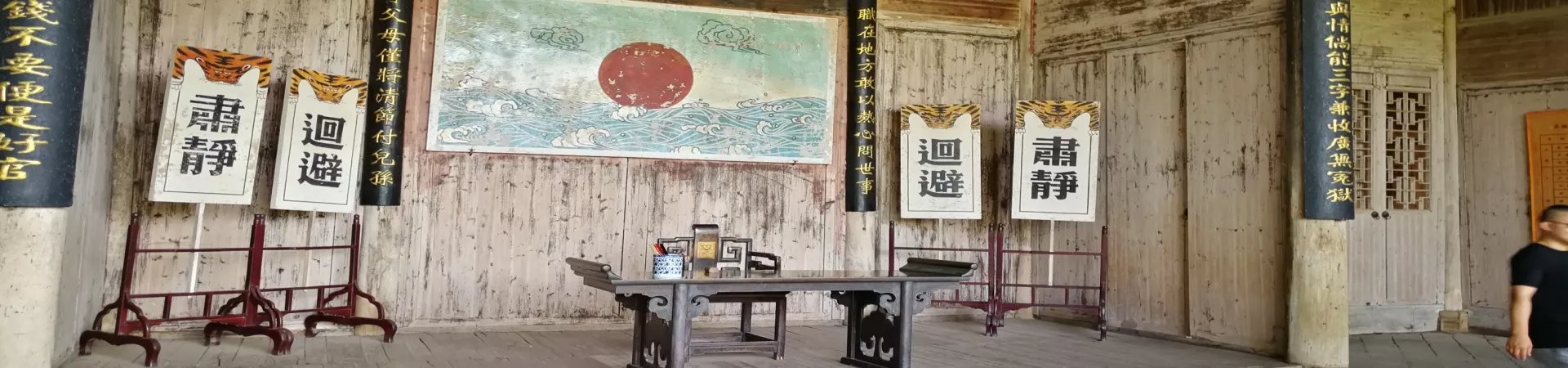
2.2. The Halls of Power and Residence The heart of the complex is the Great Hall (Datang), a spacious and austere chamber where the magistrate presided over public trials, issued pronouncements, and conducted official business, designed to inspire awe and underscore the state's authority. Behind it lies the Second Hall (Ertang), used for more private deliberations and meetings. Further in is the Third Hall (Santang), which served as the magistrate's private residence and family quarters. This seamless progression from public administrative spaces to private living areas within a single, interconnected complex—with covered corridors linking the structures—exemplifies classic Chinese architectural philosophy. The design masterfully balances solemnity with a subtle elegance, creating an atmosphere where formidable institutional power coexists with cultivated residential refinement, a duality that visitors can palpably feel as they walk its grounds.
3. Immersive Historical Collections and Cultural Insights
3.1. Artifacts of Authority and Daily Life Within the various halls and rooms, a fascinating collection of artifacts brings the Yamen's history to life. Exhibits include detailed replicas of official Qing Dynasty robes and hats, conveying the rigid hierarchy of the imperial bureaucracy. Tools of law and order are also displayed, such as traditional instruments, ancient weapons, official sedans, and judicial implements, offering a stark reminder of the legal system's practices. Particularly noteworthy are the numerous inscribed wooden plaques and couplets (Yinglian) adorning the pillars and lintels. These texts, rich in literary and philosophical meaning, often contained admonitions on virtue, justice, and governance, reflecting the Confucian ideals expected of the scholar-officials who served here.
3.2. Experiencing History Firsthand The site effectively transcends a typical museum visit. The well-preserved environment allows one to vividly envision the daily routines of magistrates, clerks, and petitioners. The famous couplet, "The imperial system has long been abolished, yet the county yamen remains," invites contemplation on the passage of time and the persistence of history. As the saying displayed here notes, "Precious historical relics, entering is beneficial." Visitors are encouraged not just to observe but to engage imaginatively, perhaps even to "play the part" of a county magistrate for a moment, pondering the weight of decisions made within these walls.
4. The Iconic Sentinel: The Red Pagoda
Dominating the skyline of the old town is the majestic Hong Ta, or Red Pagoda. This towering brick structure, revered as the "Number One Pagoda in Jiangxi," has long been celebrated as the "ancient city emblem" of Fuliang. Its enduring presence symbolizes the historical and cultural continuity of the region. While architecturally distinct from the Yamen complex, the pagoda is an integral part of the site's heritage, representing the spiritual and communal life that flourished alongside the secular administration. Its weathered facade, showing the reddish hue that gives it its name, stands as a silent witness to centuries of Fuliang's history.
Practical Visitor Information
Location: Within the Old Town of Fuliang, Jingdezhen City, Jiangxi Province. Transportation: Visitors can take Jingdezhen Public Bus Route 39 to the "Jiuchengcun (Old City Village)" bus stop and walk a short distance to the site. Opening Hours: 08:00 - 17:30 daily throughout the year, with last admission at 17:30. Admission Fees: Ticket prices are seasonal. They are approximately 25 RMB for adults from late February to late April, and around 40 RMB from late April through May. Please verify current rates before your visit. Recommended Visit Duration: 1 to 3 hours to fully appreciate the Yamen complex and the Red Pagoda. Special Notes: From March 1, 2022, to February 28, 2023, a special policy allowed free admission for national primary and secondary school students, postgraduates, and graduating university students who booked in advance via the "Yunyou Jiangxi" platform. Furthermore, from June 20, 2021, to June 20, 2024, the scenic area offers free admission to all serving police officers in Jiangxi province upon presentation of their official "People's Police Certificate." It is advisable to check for the latest updates on any such promotional policies before planning your trip. Contact: For inquiries, you may call 0798-2620150 or 0798-2621157.