Nanxun Ancient Town - Zhang Shiming's Old Residence
Subtitle: A Journey Through the Lavish World of a Merchant Prince: The Zhang Shiming Old Residence
Introduction: A Legacy in Stone and Wood Nestled within the historic fabric of Nanxun, an ancient water town in Huzhou, Zhejiang Province, stands a monument to a bygone era of immense wealth, cultural fusion, and architectural ambition. The Zhang Shiming Old Residence, also reverently known as the "Yide Hall," is far more than a mere house; it is a sprawling narrative in brick, wood, and stained glass, telling the story of one of China's most influential merchant families. Constructed by Zhang Junheng, the grandson of Zhang Songxian—one of the legendary "Four Elephants," the quartet of ultra-wealthy families who dominated Nanxun's silk trade in the late Qing Dynasty—this estate is a breathtaking embodiment of the phrase "East meets West." Universally acclaimed as the "Finest Private Residence in Jiangnan," it offers visitors an unparalleled glimpse into the luxurious lifestyle and cosmopolitan vision of China's early modern elite.
Architectural Grandeur: A Fusion of Two Worlds The sheer scale and intricate design of the residence immediately command attention. Occupying a prime location facing the ancient Xunxi River and oriented east-west, the complex is vast, structured around five main sections and four sequential courtyards, encompassing approximately 150 rooms of varying styles.
The Traditional Chinese Framework At its heart, the residence adheres to the sophisticated principles of Jiangnan garden-style architecture. The layout follows a strict axial symmetry, with courtyards (进, jin) unfolding one after another, each serving a specific social and familial function. Visitors pass through ornate gate towers into a world of carved brick, wood, and stone. Exquisite wood carvings adorn beams and door frames, depicting scenes of mythology, nature, and symbols of good fortune. Lattice windows filter sunlight into quiet studies, while elegant grey-tiled roofs sweep upwards. The courtyards, with their potted plants and tranquil atmosphere, reflect the traditional Chinese philosophical pursuit of harmony between humanity and nature, offering serene spaces for contemplation away from the bustling commercial world outside.
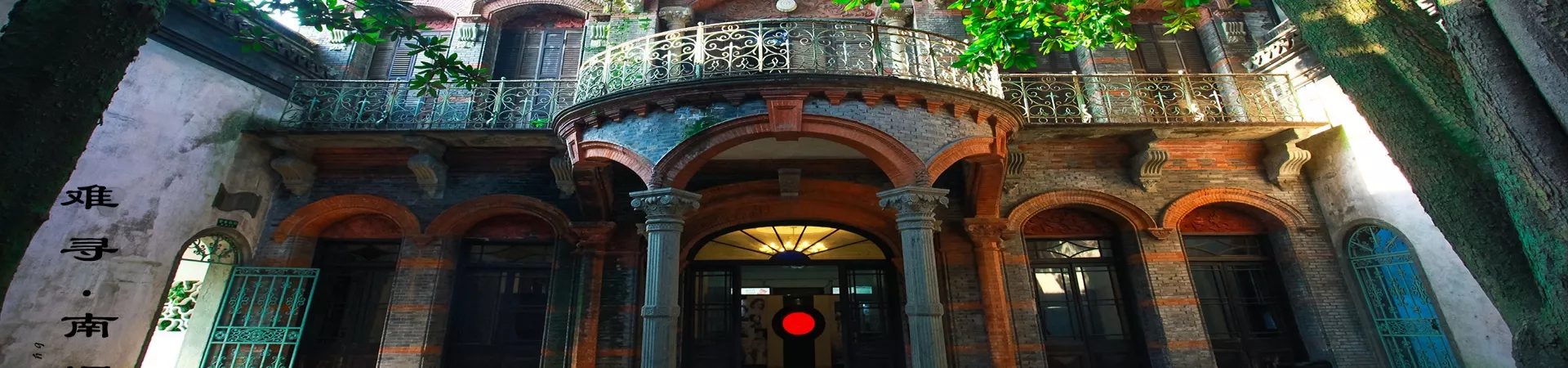
The Bold Western Infusion What truly sets the Zhang Residence apart and startles the visitor is its audacious incorporation of European architectural elements, seamlessly integrated into the traditional fabric. The most stunning example is the magnificent Ballroom and Reception Hall located in the rear section. Here, the architecture undergoes a dramatic transformation. The space is adorned with vibrant, imported French stained-glass windows casting colorful patterns on the floors, intricate carved stone columns, and elegant Romanesque arches. The walls are covered with delicately patterned ceramic tiles, and the floors are laid with polished, imported cement tiles. This section, complete with a dedicated Wine Cellar, was designed for hosting foreign guests and lavish social gatherings, showcasing the family's modern tastes and international connections. Furthermore, the exterior of one building features a Rococo-style facade, with flowing, ornate stucco decorations that contrast vividly yet harmoniously with the more reserved Chinese masonry.
A Walk Through the Estate: Key Areas and Features Navigating the residence is a journey through different aspects of late Qing dynasty life.
The Main Halls and Ceremonial Spaces The initial halls, such as the main Yide Hall, were the formal centers of family life and business. These spaces, furnished with traditional rosewood furniture, ancestral altars, and scholarly inscriptions, were used for receiving important Chinese guests, conducting family ceremonies, and upholding Confucian rituals. The decor here emphasizes cultural heritage, social status, and scholarly refinement.
The Inner Quarters and Living Spaces Moving deeper into the complex, one finds the more private living quarters for family members. These interconnected rooms and smaller courtyards provide a sense of the daily domestic life of the Zhang family. The design here prioritizes privacy, comfort, and the intricate social hierarchy within a large household.
The Rear Garden and Western Wing The climax of the tour is the discovery of the Western-style wing at the rear. This area highlights the family's embrace of global trends. The aforementioned ballroom stands as the centerpiece, a space dedicated to leisure and entertainment in a wholly foreign style. Adjacent service areas, like the kitchen and cellar, were also modernized to support this new lifestyle. This architectural duality perfectly symbolizes the period's transition: a deep-rooted Chinese identity confidently engaging with and adopting foreign innovations.
Practical Visitor Information
Location and Transportation The Zhang Shiming Old Residence is situated within the pedestrian-friendly core area of Nanxun Ancient Town. * On Foot: The most convenient and recommended way to reach the residence is by walking through the scenic lanes and along the canals of the ancient town. * Taxi: Taxis are available in Nanxun but are not exceedingly numerous. The flag-down fare starts at approximately 5 RMB for the first 2 kilometers, with an additional 2 RMB per kilometer thereafter. * Pedicab: Human-powered tricycle pedicabs are a classic and convenient mode of transport within the town. Fares are negotiable but generally cost around 3 RMB per kilometer. A typical ride from the Taian Road Bus Station to the ancient town entrance costs about 8 RMB, while from the long-distance bus station it may range from 10 to 15 RMB.
Admission Fees * Entrance Ticket: 20 RMB per person. This fee typically grants access to the Zhang Shiming Old Residence complex. (Prices are valid year-round, Monday through Sunday).
Opening Hours * Peak Season (April 1 - October 31): 7:30 AM - 5:30 PM, Monday through Sunday. * Off-Peak Season (November 1 - March 31): 8:00 AM - 5:00 PM, Monday through Sunday.
Suggested Visit Duration To fully appreciate the architectural details, explore the numerous rooms, and understand the historical context, a visit of 1.5 to 3 hours is recommended. This allows for a leisurely pace to contrast the Eastern and Western sections and imagine the vibrant life that once filled these halls.