Liu's ladder number
Subtitle: A Journey Through Time: Where East Meets West in Nanxun's "Red House"
Introduction: The Crimson Jewel of Nanxun
Nestled within the historic waterways of Nanxun Ancient Town in Huzhou, China, stands Liu's Stepped Compound, an architectural marvel that instantly captivates visitors with its striking crimson walls. Affectionately known as the "Red House," this estate is far more than a picturesque landmark; it is a profound physical narrative of a pivotal era in Chinese history. Built as the residence for Liu An, the third son of the immensely wealthy merchant Liu Yong (a leading figure among Nanxun's legendary "Four Elephants" tycoons), the compound embodies the spirit of the late Qing Dynasty. This was a time when progressive Chinese industrialists and scholars, influenced by growing global interactions, began to look westward, integrating foreign ideas and aesthetics into the deeply rooted traditions of their homeland. The Red House stands as a magnificent testament to this cultural fusion, offering a unique lens through which to explore the convergence of Chinese heritage and European elegance.
Architectural Grandeur: A Symphony of Two Worlds
The compound's layout is a study in harmonious contrast, organized into three distinct sections: south, central, and north. While the central structures largely adhere to the classical principles of Jiangnan water-town architecture—characterized by elegant grey-brick walls, serene courtyards, and gracefully sloping tiled roofs—it is the northern and southern sections that unveil the estate's bold, innovative heart.
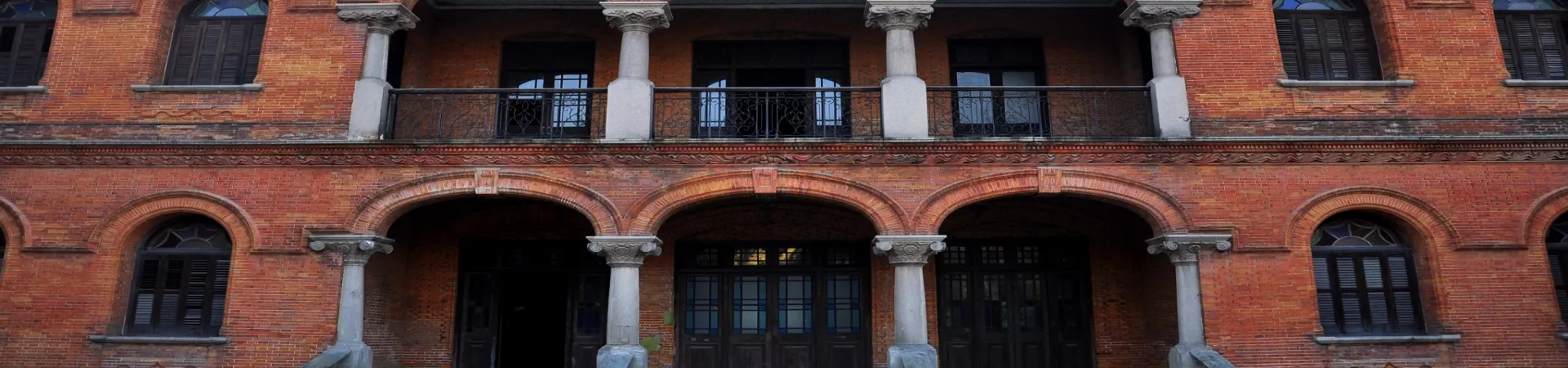
The Roman-Inspired Facades Here, the visitor encounters a breathtaking surprise: the seamless incorporation of Romanesque architectural elements. Grand, arched colonnades supported by robust pillars, intricate stone window carvings, and ornate balustrades rise imposingly, rendered in the estate's signature vibrant red hue. This bold use of color and form creates a dramatic visual dialogue with the more subdued Chinese structures, symbolizing the confident embrace of foreign influences by the Liu family. The "Red House" moniker is derived directly from these striking Western-style sections, making them an unforgettable and photogenic highlight.
Interior Artistry: A Treasure Trove of Craftsmanship Stepping inside, the grandeur continues. The interiors are a testament to unparalleled Chinese artisanry, housing a breathtaking collection of carvings that demand close inspection.
- Exquisite Woodwork: Elaborate wooden screens, door frames, and beams feature detailed reliefs depicting traditional scenes of nature, mythology, and symbols of prosperity. The craftsmanship showcases motifs like coiling dragons, delicate phoenixes, and lush floral patterns, each telling a story or conveying a blessing.
- Intricate Brick and Stone Sculptures: Throughout the chambers and corridors, visitors will find stunning brick and stone carvings. These range from decorative wall panels and friezes to functional yet artistic elements, demonstrating a mastery of texture and narrative depth that complements the architectural splendor.
The "Little Red House": A Secret Within a Secret Adding another layer to the experience is a particularly charming structure often referred to as the "Little Red Mansion." From its external appearance, it perfectly mimics a traditional Jiangnan-style building, blending innocuously into the local architectural tapestry. However, upon entering, one is transported entirely. The interior is a fully realized Western-style space, complete with period furnishings and decor. This clever architectural sleight of hand serves as a delightful metaphor for the compound's overall theme—outward tradition guarding an inward-looking cosmopolitanism—and provides an exceptionally atmospheric setting for photography.
Visitor Information: Planning Your Visit
Location and Transportation Liu's Stepped Compound is situated within the pedestrian-friendly confines of Nanxun Ancient Town. * On Foot: The most immersive way to arrive is by walking through the ancient town's lanes and canals. * Taxi: Taxis in Nanxun are available but not abundant. The metered fare starts at 5 RMB for the first 2 kilometers, with 2 RMB added per subsequent kilometer. * Pedicab: Human-powered tricycles are a popular and convenient local transport. Fares are negotiable, typically around 3 RMB per kilometer. A ride from the Taian Road Bus Station to the ancient town usually costs approximately 8 RMB, while trips from the long-distance bus station range from 10 to 15 RMB.
Admission and Opening Hours * Ticket Price: 20 RMB per person. * Operating Hours: The compound is open daily from 8:00 AM to 5:00 PM. * Suggested Duration: To fully appreciate the architecture, gardens, and interior details, a visit of 1 to 3 hours is recommended.
Contact For any inquiries prior to your visit, you may contact the site at: 0572-3016999.