Baijian Building
Subtitle: A Timeless Waterway: Exploring Nanxun's Bai Jian Lou Residential Corridor
Introduction: The Soul of a Water Town
Nestled within the historic fabric of Nanxun Old Town, the Bai Jian Lou (Hundred Houses) stands not merely as a scenic spot but as the living, breathing heart of a classic Jiangnan water community. Unlike the more commercialized sections of many ancient towns, this 400-year-old residential corridor offers an authentic and serene glimpse into the rhythms of daily life along the canals, where history is not preserved behind glass but is woven into the very walls and waterways. A visit here is a journey into the architectural elegance and communal spirit of Ming Dynasty China, still palpable in the soft light of the present day.
1. History and Legend: A Legacy in Stone and Plaster
The story of Bai Jian Lou begins in the Ming Dynasty, over four centuries ago, with a tale of remarkable patronage. It is said that the complex was commissioned by Dong Fen, a prominent Minister of Rites, to provide housing for the servants and retainers of his wealthy household. This origin story is crucial to understanding its character. These were not built as showpieces for the elite, but as functional, dignified homes for the community that supported a grand estate. The name "Hundred Houses" is somewhat figurative, suggesting a large, continuous stretch of dwellings rather than a precise count. This historical foundation establishes Bai Jian Lou not as a palace or a temple, but as a monumental testament to communal living and social structure in ancient Huzhou.
2. Architectural Harmony: A Symphony of White Walls and Black Tiles
The defining aesthetic of Bai Jian Lou is one of understated, harmonious beauty that perfectly adapts to its aquatic environment.
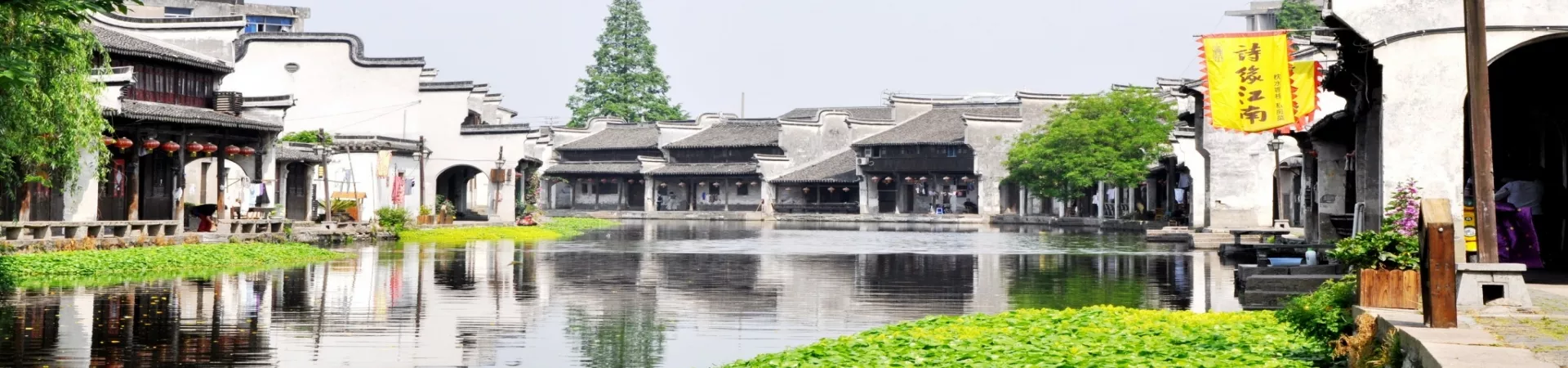
2.1. The Riverside Facade The most iconic view is the uninterrupted line of dwellings along the eastern bank of the canal. The architecture follows a consistent pattern: white-plastered walls, dark grey ("qing wa") roof tiles, and elegantly simple wooden facades facing the water. The buildings are "yi he li lou" – erected directly along the riverbank. Their reflections shimmer in the calm water, doubling the visual poetry. Slender willow trees drape their branches towards the water, adding softness and a sense of timeless grace to the scene.
2.2. Structural Unity and Variation The houses are constructed in connected rows, with shared side walls, creating a unified streetscape that emphasizes community. The most concentrated and photogenic section runs between the Lotus Flower Bridge (Lianhua Qiao) and the Long Bridge (Chang Qiao) on the canal's eastern shore. Despite the overall uniformity, close observation reveals subtle variations in roof lines, gable designs, and the size of stone portals, hinting at the individuality within the collective whole.
2.3. Functional Design: Porches and Portals A key architectural feature is the covered veranda or colonnade that runs along the waterfront. This sheltered walkway, supported by wooden pillars rising from the riverbank, provides residents and visitors alike with shade from the sun and protection from the rain. Beneath these verandas, stone steps lead from heavy wooden doors down to the water's edge, where boats were once moored, illustrating the intimate relationship between daily life and the canal.
3. The Living Community: Authenticity Over Restoration
Perhaps the most compelling aspect of Bai Jian Lou is that it remains a vibrant residential neighborhood. This is not an open-air museum frozen in time.
3.1. A Neighborhood with Character Local Nanxun residents continue to live in these historic homes. Laundry hangs between pillars, bicycles lean against ancient walls, and the sounds of domestic life drift through open windows. While the passage of centuries has left its mark—walls show weathering, and plaster has peeled in places—this patina of age is precisely what lends the area its profound authenticity and charm. The "character" comes from this continued, unpretentious use.
3.2. A Respite from Commerce In refreshing contrast to other ancient town streets, Bai Jian Lou is notably quiet. It is largely free from the ubiquitous souvenir shops, loud restaurants, and commercial bustle. The ground floors of some houses may host a small, low-key family-run tea shop or craft stall, but they feel integrated into the residential fabric rather than dominating it. The primary atmosphere is one of tranquil habitation.
4. Practical Information for the Visit
4.1. Location and Access Bai Jian Lou forms the northern part of the Nanxun Old Town scenic area, stretching along a canal. Access is included within the general admission ticket to Nanxun Old Town. There is no separate entrance fee for Bai Jian Lou itself.
4.2. Opening Hours and Duration The area is open to the public 24 hours a day, every day of the year. Its open-air, residential nature means it is always accessible once within the old town. To fully appreciate its atmosphere—observing the light change on the walls, wandering the quiet verandas, and perhaps capturing it in the soft morning light or the golden glow of evening—a visitor should allocate at least 3 hours. This allows for a leisurely stroll, photography, and time to simply sit and absorb the serene environment.
4.3. Experiential Tips The essence of visiting Bai Jian Lou is slow immersion. Walk slowly along the covered verandas. Cross the stone bridges for different vantage points, particularly from the west bank looking back towards the main facade. Early morning offers misty, peaceful scenes with locals beginning their day, while late afternoon provides beautiful lighting and fewer visitors. Remember that you are walking through people's neighborhoods; a respectful and quiet demeanor is appreciated. For any specific inquiries, the general Nanxun Old Town visitor center can be contacted.