Qianfo Cliff Scenic Area
Subtitle: A Millennium-Old Treasury of Buddhist Rock Carvings Along the Ancient Shu Path
1. Introduction: A Cliff of a Thousand Buddhas
Nestled approximately 4 kilometers north of Guangyuan city, on the eastern bank of the Jialing River and along the historic金牛道 (Golden Ox Road) of the ancient Shu paths, lies the awe-inspiring Qianfoya (Thousand-Buddha Cliff) Scenic Area. This site is not merely a collection of stone carvings; it is a profound historical narrative etched into a cliff face, representing over a millennium of religious devotion, artistic evolution, and cultural exchange. As one of Sichuan's most magnificent and expansive grotto complexes, Qianfoya stands as a silent yet eloquent testament to the spread of Buddhism and the zenith of Chinese rock-carving artistry.
2. Historical Significance and Artistic Grandeur
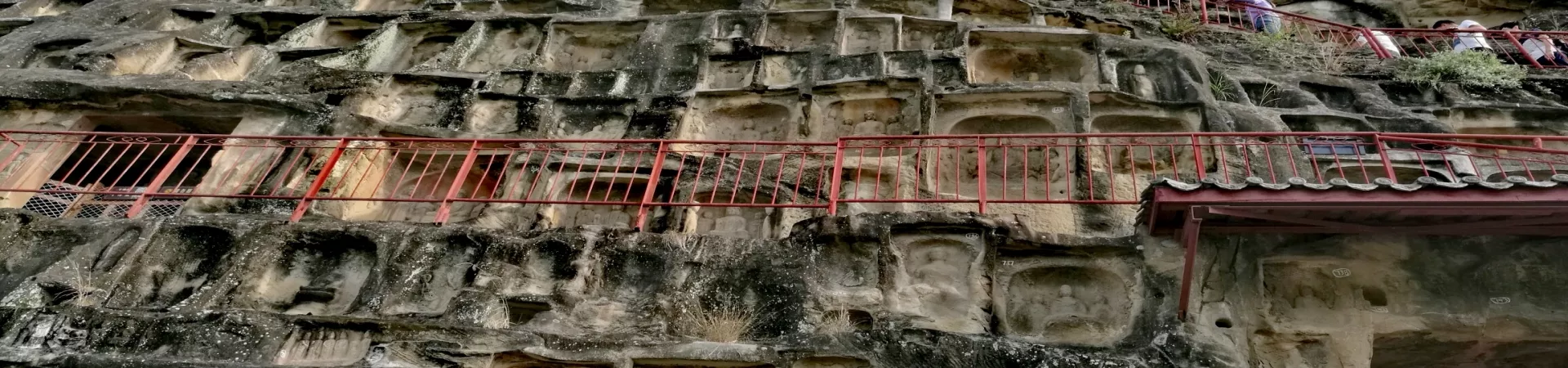
2.1. A Journey Through Dynasties The creation of this sacred site began in the late Northern Wei Dynasty (386-535 AD), flourished throughout the Tang Dynasty (618-907 AD)—a golden age for Buddhist art in China—and continued intermittently until the Qing Dynasty (1644-1912 AD). This sustained effort across centuries resulted in an immense artistic treasure trove: a cliff stretching nearly 388 meters in length and soaring up to 45 meters in height, densely populated with over 950 niches housing more than 7,000 individual Buddhist statues. The layout, with its layers of niches resembling a vast honeycomb, creates a visually staggering effect.
2.2. Recognition and Status In acknowledgment of its immense cultural value, Qianfoya was designated among the first batch of Major Historical and Cultural Sites Protected at the National Level by China's State Council in 1961. It forms an integral part of the Jianmen Shu Road National Scenic Area and holds a pivotal position as a core heritage site of the "China Shu Road: Golden Ox Road – Guangyuan Section," which is on the UNESCO World Heritage Tentative List. Its management and preservation standards were further recognized in 2012 when it was rated as a National AAAA-level Tourist Attraction.
3. Architectural and Artistic Highlights
3.1. Masterpieces in Stone Among the numerous caves and niches, several stand out for their historical importance, architectural innovation, and exquisite craftsmanship. Key caves include: * The Great Buddha Cave (Dafo Ku): Often a central, imposing figure, setting the tone for the site. * Lotus Cave (Lianhua Dong) & Bodhi Auspicious Image Cave (Puti Ruixiang Ku): Showcasing intricate iconography and symbolic motifs prevalent in Buddhist art. * Dayun Ancient Cave (Dayun Gudong) & Vairocana Buddha Niche (Lushena Fokan): Reflecting high theological concepts and the influence of esoteric Buddhism. * Muni Pavilion (Moni Ge), Sleeping Buddha Niche (Shuifo Kan), and Lotus-Holding Guanyin Cave (Chilian Guanyin Ku): Demonstrating diverse representations of Buddhist deities and narratives. * Tibetan Buddhist Cave (Zangfo Dong): Indicating the site's diverse influences and prolonged use.
3.2. A Link to Imperial Capitals What makes Qianfoya exceptionally significant is its direct artistic connection to the heart of the Tang Empire. Many of its most representative caves were commissioned by officials hailing from the "Two Capitals"—Chang'an (modern Xi'an) and Luoyang. Consequently, the styles, themes, and techniques embodied here directly mirror the prevailing Buddhist artistic fashions and the highest skill levels of the central plains during that era. Notably, the site features unique "central altar with back-screen" style caves, an architectural form considered unparalleled in other Chinese grotto complexes.
4. Practical Visitor Information
4.1. Location and Transportation The site is conveniently located just north of downtown Guangyuan. Visitors can easily reach it by taking public bus routes 5 or 7 and alighting at the "Qianfoya (Bus Stop)." From the bus stop, the entrance is within short walking distance.
4.2. Admission Fees and Policies * Standard Ticket: 50 RMB for adults. * Free Admission: Applicable to children under 1.2 meters in height; seniors aged 65 and over (with valid ID or senior citizen certificate); active-duty military personnel (with officer certificate); individuals with disabilities (with disability certificate); and national fire and rescue personnel (with valid ID). * Note for Seniors: Seniors aged 60 to 64 enjoy free admission on non-national holidays but are required to purchase a half-price ticket during official national holidays. * All ticket information is for reference only. Please confirm the latest prices and policies at the ticket office on the day of your visit.
4.3. Opening Hours The scenic area is open daily from 08:00 to 17:00, with last admission at 17:00. It is advisable to allocate approximately 1 to 3 hours for a thorough visit to appreciate the scale and detail of the carvings.
4.4. Suggested Experience A visit to Qianfoya is a journey back in time. As you walk along the pathways and staircases built against the cliff, take time to observe the evolution in sculptural style—from the relatively slender and abstract figures of the Northern Wei to the more rounded, lifelike, and majestic statues of the High Tang period. The setting, overlooking the Jialing River, also invites contemplation of the countless travelers, pilgrims, and artisans who once passed this very point on the ancient, strategic Shu Road.