Longpanji
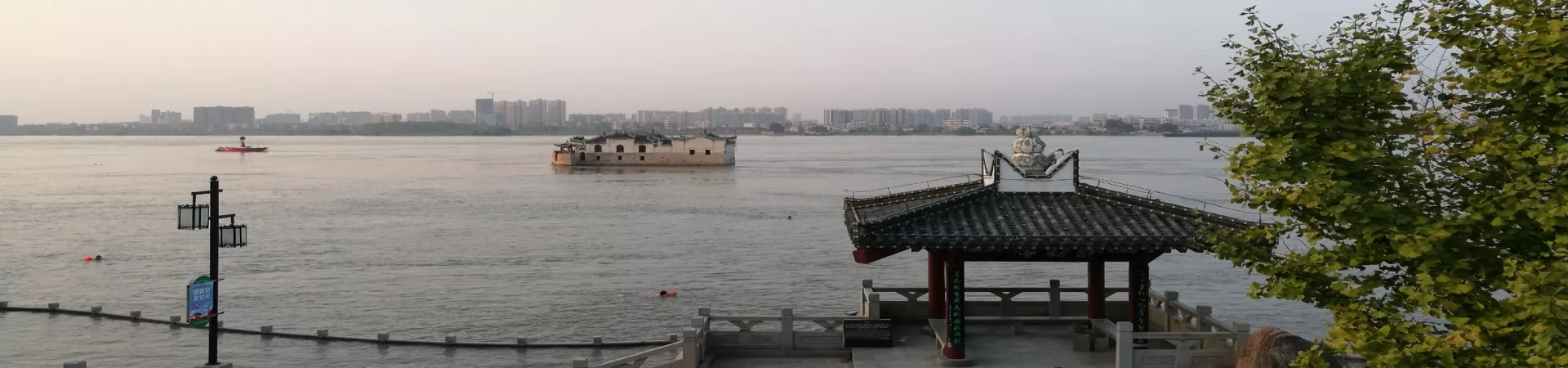
Subtitle: The Enduring Sentinel of the Yangtze: Longpanji and the Guanyin Pavilion
I. A Dragon Emerges from the River: History and Legend
In the mighty Yangtze River, just east of Ezhou's old city wall, lies a colossal rock reef. Its form winds and coils through the water like a powerful, sinuous dragon, earning it the name Longpanji, or "Coiling Dragon Reef." Its story is deeply entwined with the dawn of the Three Kingdoms period. In 221 AD, Sun Quan, the king of Eastern Wu, moved his capital to E County, renaming it "Wuchang" to signify "prosperity through military strength." On the eve of his declaration as emperor, legend holds that a yellow dragon was seen coiled upon this river rock for many days before departing. Interpreting this as a supreme auspicious omen—a dragon, symbol of the emperor, blessing his new capital—Sun Quan named the site "Coiling Dragon Reef." It formed a perfect geomantic pair with the "Phoenix Terrace" on the eastern bank, embodying the "dragon coils and phoenix gathers" prophecy ideal for an imperial seat.
Later folklore enriched its mystique, suggesting the Bodhisattva Guanyin herself was drawn to the site's potent feng shui, choosing it for meditation and rest. Perched defiantly on the western, upstream end of this dragon-shaped rock—as if on the very head of the beast looking west—is the extraordinary Guanyin Pavilion (Guanyin Ge), often hailed as "The First Pavilion on the Ten-Thousand Li Yangtze."
II. Architectural Marvel Defying the Torrent: The Guanyin Pavilion
A. Construction and Resilience The pavilion's recorded history begins in the Yuan Dynasty, built by the local magistrate Tieshan. It has undergone numerous repairs and reconstructions through the Ming (notably during the Hongzhi and Jiajing reigns), Qing, and Republican eras, a testament to its enduring significance and the relentless challenge posed by its environment. The structure is a masterpiece of pre-modern engineering and adaptive architecture. Measuring approximately 24 meters long, 10 meters wide, and 14 meters high, it is a timber-framed pavilion-style building constructed upon a solid base of stone blocks and grey brick.
B. Design Ingenuity Its most remarkable feature is the curved, ship's hull-like stone wall at its base. This brilliant design serves a dual purpose: it disrupts and slows the ferocious impact of the river's current while allowing water to flow smoothly around it. For centuries, this design has enabled the pavilion to withstand seasonal floods that would have obliterated less cleverly conceived buildings. During the summer flood season, the rising Yangtze often submerges the lower levels, leaving only the upper windows, eaves, and rooftop pavilions visible above the swirling, muddy waters—a surreal image of a building afloat in the vast river. As the Qing official Guan Wen poetically noted, it stands as a "pillar in mid-stream." When the floods recede, the pavilion emerges once more, majestic and unyielding, a silent demonstration of ancient Wuchang craftsmen's intuitive understanding of hydrodynamics and their unique architectural artistry.
III. A Journey Through the Pavilion: Layout and Features
The pavilion's main facade bears three strong, carved characters: "观音阁" (Guanyin Ge). Inside the main entrance, a stone stele inscribed with "龙蟠晓渡" ("Morning Ferry at Coiling Dragon") greets visitors, the calligraphy a work by the aforementioned official Guan Wen, who was reportedly inspired by the view from the Red Cliff across the river.
A. The Interior Layout The interior, covering over 300 square meters, is arranged sequentially from west to east: 1. 观澜亭 (Guanlan Ting): The "Wave-Viewing Pavilion." From here, one can look down upon the powerful currents of the Yangtze, a scene of immense grandeur. 2. 东方朔殿 (Dongfang Shuo Dian): A hall dedicated to Dongfang Shuo, a witty Han Dynasty scholar and court figure later immortalized in Daoist folklore. 3. 观音殿 (Guanyin Dian): The central hall, enshrining the Bodhisattva of Compassion. 4. 老君殿 (Laojun Dian): A hall dedicated to Lao Jun, the deified form of Laozi, the founder of Daoism. 5. 纯阳楼 (Chunyang Lou): The "Pure Yang Tower," dedicated to Lü Dongbin, one of the Eight Immortals. A charming statue here depicts him in deep,酣睡 (sound sleep), a sight that often brings a knowing smile to visitors, acknowledging that this indeed seems a perfect paradise for an immortal.
B. Artistic and Devotional Elements The halls house simple yet dignified stone statues of Guanyin and vivid clay sculptures of the Eight Immortals. Throughout the structure, craftsmanship shines in carved dragons and phoenixes, staggered eaves, and soaring roof ridges.
IV. Lore, "Three Wonders," and Eternal Allure
The pavilion is enveloped in enduring local legends. One tale claims it could once rise and fall with the tides. The reef originally had two hollows, said to be the eyes of a giant divine turtle ("神鳖"), one producing cooking oil and the other salt. A greedy monk, seeking greater bounty, widened the holes, only to blind the turtle and end the miraculous flow forever, also causing the pavilion to lose its ability to float.
The "Three Wonders" (三趣) of Guanyin Pavilion are: 1. The Ancient Well: A well inside the pavilion whose water level has historically remained several feet higher than the surrounding river water, and is famously clear. 2. The Resurrected Trees: Several ancient trees rooted in the stone walls, which had withered for years, have recently shown new life, sprouting fresh buds—a symbol of enduring vitality. 3. The "Divine Turtle's Eyes": The two hollows on the reef, the centerpiece of the enduring legend.
These stories and natural curiosities, passed down through generations, continue to captivate the imagination. They complement the sheer physical awe inspired by the Guanyin Pavilion—a structure that is not merely a building but a living dialogue between human devotion, architectural genius, and the untamable power of nature. It stands as Ezhou's most iconic sentinel, having witnessed over seven centuries of the Yangtze's endless flow and the unfolding of history on its banks.
Practical Information
- Ticket: For specific details, please inquire directly at the scenic area.
- Opening Hours: Open 24 hours a day, all year round.