Mount Qingcheng
A Visitor's Guide to Qingcheng Mountain: China's Serene Taoist Sanctuary
Nestled in the west of Dujiangyan City, approximately 68 kilometers southwest of downtown Chengdu, lies Qingcheng Mountain. Revered as one of the birthplaces of Taoism in China, this mountain range has captivated visitors for centuries with its profound tranquility, earning the enduring epithet "天下幽" (Tian Xia You), which translates to "the most serene mountain under heaven." Its lush, emerald-green forests cloak ancient temples and winding paths, creating an atmosphere of secluded mysticism that stands in stark, peaceful contrast to the bustling energy of nearby Chengdu. For travelers seeking a deep dive into spiritual history or simply a day immersed in pristine natural beauty, Qingcheng Mountain offers a uniquely restorative experience, conveniently accessible yet worlds away.
Understanding the Two Sides: Front Mountain vs. Back Mountain The mountain is distinctly divided into two main scenic areas: the Front Mountain (前山) and the Back Mountain (后山). This division is crucial for planning your visit, as each offers a dramatically different experience in terms of cultural focus, physical demand, and overall ambiance.
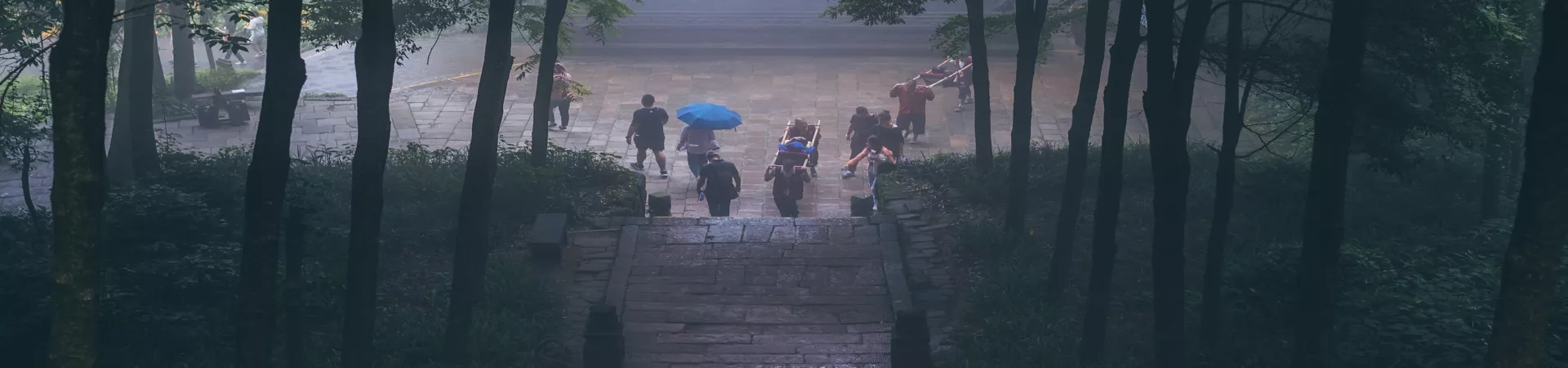
The Front Mountain: A Cultural Pilgrimage The Front Mountain is the smaller, more developed, and far more frequented section. It is the heart of Qingcheng's Taoist heritage. Here, the saying "almost a temple every hundred steps" holds true. The area is a dense concentration of ancient palaces, temples, and pavilions, including the renowned Jianfu Palace (建福宫) and the summit's Shangqing Palace (上清宫). These architectural gems, with their elegant curved roofs and intricate carvings, seem to emerge organically from the dense canopy of ancient cypress and pine trees. Visiting the Front Mountain feels like walking through a living museum of Taoist culture and philosophy. The paths, while involving a significant amount of stair climbing, are well-paved and connect the major sites efficiently, making it suitable for most visitors. The air is often fragrant with incense, and the sound of temple bells mingles with the rustle of leaves, reinforcing its sacred, albeit more visited, atmosphere.
The Back Mountain: A Naturalist's Retreat In contrast, the Back Mountain is vast, rugged, and maintains a remarkably raw and primitive character. It is primarily a destination for hiking enthusiasts and those seeking unspoiled natural scenery. While there are a few temples, such as the Tai'an Temple (泰安寺) at its foot, they are fewer and see less incense smoke than their Front Mountain counterparts, resulting in a quieter, more austere feel. The appeal here lies in its deep gorges, cascading waterfalls, crystal-clear streams, and dense, untouched forests. Hiking trails are more challenging and longer, leading adventurers through breathtaking landscapes like the picturesque Fly Spring Cave (飞泉沟) and Cuiping Lake (翠映湖). The Back Mountain delivers on the promise of "serenity" in its purest form—a place for contemplation accompanied only by the sounds of nature.
Essential Planning Information: Tickets, Hours, and Transit
Getting to Qingcheng Mountain Reaching Qingcheng Mountain from Chengdu is straightforward, with multiple options available: * By High-Speed Rail (Recommended): From Chengdu's Xipu Railway Station (犀浦站), take a high-speed train to the Qingchengshan Station. Over ten services run daily, with a journey time of around 40 minutes and a fare of approximately 10 RMB. Upon arrival, take local bus 101 or 102 directly to the mountain entrance. * By Long-Distance Bus: Direct buses to Qingcheng Mountain depart from Chengdu's Chadianzi Bus Station (茶店子汽车站). Alternatively, buses to the Back Mountain area are available from the Xinnanmen Tourist Bus Center (新南门客运站). * Local Transit: Within the Qingchengshan town area, buses 101 and 102 circulate between the Front Mountain, Back Mountain, and Dujiangyan. Simply confirm with the driver that the bus is headed to "Qingcheng Front Mountain" before boarding. A taxi between the Front and Back Mountain entrances costs around 10 RMB.
Admission Fees Ticket prices are separate for the two sections: * Front Mountain: Adult ticket: 80 RMB; Student ticket (full-time undergraduate and below): 40 RMB; Parent-Child ticket (for children aged 6-18 without ID): 119 RMB. * Back Mountain: Adult ticket: 20 RMB; Student ticket: 10 RMB; Parent-Child ticket: 30 RMB. * Important Notes: Student ticket holders must present a valid student ID card for verification upon entry. The Parent-Child ticket is specifically for minors within the stated age range who are not carrying their ID cards.
Operating Hours The opening hours vary slightly between seasons: * Summer (Approx. May - October): 8:00 AM - 5:30 PM. * Winter (Approx. November - April): 8:30 AM - 5:00 PM. It is advisable to allocate a full day for exploring either the Front Mountain thoroughly or for a substantial hike in the Back Mountain. Starting your journey early from Chengdu is highly recommended to make the most of your visit and avoid the largest crowds, particularly at the Front Mountain.
Crafting Your Experience Your choice between the Front and Back Mountain should align with your interests. For first-time visitors interested in history, culture, and iconic Taoist sites, the Front Mountain is the essential choice. It provides a concentrated and accessible introduction to the mountain's spiritual significance. For seasoned hikers, nature photographers, or those who prioritize solitude and strenuous physical activity amidst stunning scenery, the Back Mountain is an unparalleled escape. Some visitors with two days to spare choose to experience both, often pairing the Front Mountain with a visit to the nearby Dujiangyan Irrigation System, a UNESCO World Heritage site. Regardless of your choice, Qingcheng Mountain promises a journey into the peaceful heart of Sichuan's cultural and natural landscape, where the ancient Daoist pursuit of harmony with nature is palpably alive in every shaded path and mist-shrouded peak.