Dujiangyan Irrigation Project Scenic Spot
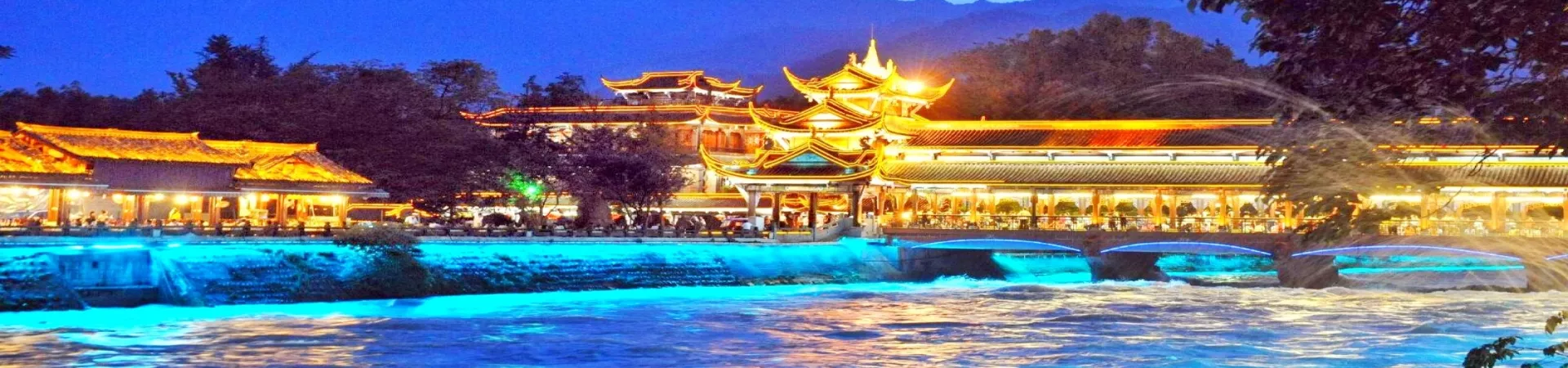
Subtitle: A Timeless Marvel of Hydraulic Engineering and Scenic Beauty
1. Introduction Nestled where the Min River flows from the mountains onto the Chengdu Plain, the Dujiangyan Irrigation System stands as a testament to ancient Chinese wisdom and ingenuity. More than just a scenic spot, it is a living, functioning masterpiece of hydraulic engineering, a UNESCO World Heritage Site, and a place where history, culture, and natural beauty converge seamlessly. Unlike modern dams that block rivers, Dujiangyan represents a philosophy of harmonious coexistence with nature, a system designed to work with the water's flow rather than against it. For any visitor to Sichuan, a day spent exploring Dujiangyan offers profound insights into a civilization's relationship with its environment and a chance to walk among serene landscapes shaped over two millennia.
2. The Engineering Marvel: A System in Harmony with Nature 2.1. Historical Significance and Core Philosophy Constructed around 256 BC under the supervision of Li Bing, the governor of the Shu Prefecture, and his son, Dujiangyan is the world's oldest and only surviving grand-scale hydraulic project that utilizes a "no-dam" water diversion method. Its creation tamed the frequently flooding Min River, transforming the fertile yet flood-prone Chengdu Plain into the "Land of Abundance" (Tianfu Zhi Guo) that has sustained Sichuan's population for centuries. The core genius of the system lies in its elegant simplicity and sustainability—it guides, divides, and channels water using natural topographical features and fundamental physical principles, requiring no artificial barriers to function.
2.2. The Three Integral Components The system's enduring success hinges on three ingeniously interconnected structures that work in concert.
2.2.1. Yuzui (Fish Mouth Levee) This iconic, fish-mouth-shaped dividing levee is the first critical component. Built from long, woven bamboo baskets filled with stones, it splits the Min River into an inner river (Neijiang) and an outer river (Wajiang). The levee's curved shape and strategic placement leverage the river's natural flow dynamics: during the dry season, approximately 60% of the water is directed into the inner river for irrigation, while 40% flows into the outer river. In the flood season, this ratio reverses automatically, preventing excessive water from entering the irrigation network.
2.2.2. Feishayan (Flying Sand Spillway) Located further down the inner river, the Feishayan is a spillway designed for flood discharge and sediment removal. Its carefully calibrated height allows excess water from the inner river to overflow into the outer river during high water levels. More remarkably, it uses a spiral flow effect to expel up to 80% of the silt and sand carried by the river, preventing the irrigation canals from clogging. This self-cleaning mechanism is a cornerstone of the system's longevity.
2.2.3. Baopingkou (Precious Bottle Neck) The final and most dramatic component is Baopingkou, a man-made channel cut through a mountain ridge called Mount Yulei. This 20-meter-wide "neck" acts as the precise inlet for the inner river, strictly controlling the volume of water entering the irrigation network that fans out across the Chengdu Plain. The story of its construction, involving fire and water to heat and cool the rock until it cracked, is legendary. Together, these three parts form a perfectly balanced system for diversion, irrigation, flood control, and silt discharge.
3. Cultural and Scenic Attractions Within the Park The Dujiangyan complex is not solely an engineering site; it is a cultural park dotted with temples, bridges, and pavilions set against a backdrop of lush greenery and flowing water.
3.1. Key Historical Sites 3.1.1. Erwang Temple (Two Kings Temple) Perched on the cliffside overlooking the river, this temple is dedicated to Li Bing and his son, who were later deified as kings. With its layered halls climbing the hill, it offers both reverent atmosphere and spectacular panoramic views of the entire irrigation system.
3.1.2. Fulong Temple (Dragon-Taming Temple) Situated on a promontory above the Baopingkou, this temple is associated with the legend of Li Bing subduing a river dragon. It now houses important historical relics, including a stone statue of Li Bing from the Eastern Han Dynasty.
3.1.3. Anlan Suspension Bridge Also known as the "Couple's Bridge," this iconic, swaying footbridge spans the turbulent river above the Fish Mouth. Crossing it is an exhilarating experience and provides a unique, mid-river perspective of the levee.
3.2. Additional Points of Interest 3.2.1. Yulei Pass (Jade Fortress Pass) An ancient gateway and military pass located on the trail, offering historical context about the area's strategic importance.
3.2.2. Lidui Park (Detached Mound Park) This park surrounds the large, separated rock mass from which the Baopingkou channel was cut. It's a tranquil area with gardens, bonsai displays, and memorials, providing a peaceful contrast to the powerful waterworks.
4. Practical Visitor Information 4.1. Tickets and Operating Hours Ticket prices are as follows: Standard Adult Ticket: 80 RMB; Student Ticket (full-time undergraduate and below): 40 RMB (ID and student card required for verification); Family Ticket (for one adult and one minor aged 6-18 without ID): 120 RMB. It is always advisable to check the official website or on-site notices for the most current pricing and policy details. The park's operating hours are seasonal: Summer (approx. April-October): 08:00 - 18:00, with last ticket sales at 17:30. Winter (approx. November-March): 08:00 - 17:30, with last ticket sales at 17:00.
4.2. Transportation and Suggested Duration The most straightforward public transportation option from downtown Chengdu or the Dujiangyan city area is to take the Dujiangyan Bus No. 1 and alight at the Erwang Temple station, which provides direct access to one of the main park entrances. To fully appreciate the engineering principles, explore the major cultural sites, and enjoy the landscapes at a comfortable pace, allocating a full day (approximately 6-8 hours) for the visit is highly recommended.
4.3. Contact Information For general inquiries, visitors can contact the scenic area at 028-96526.