Taohuayuan National Forest Park
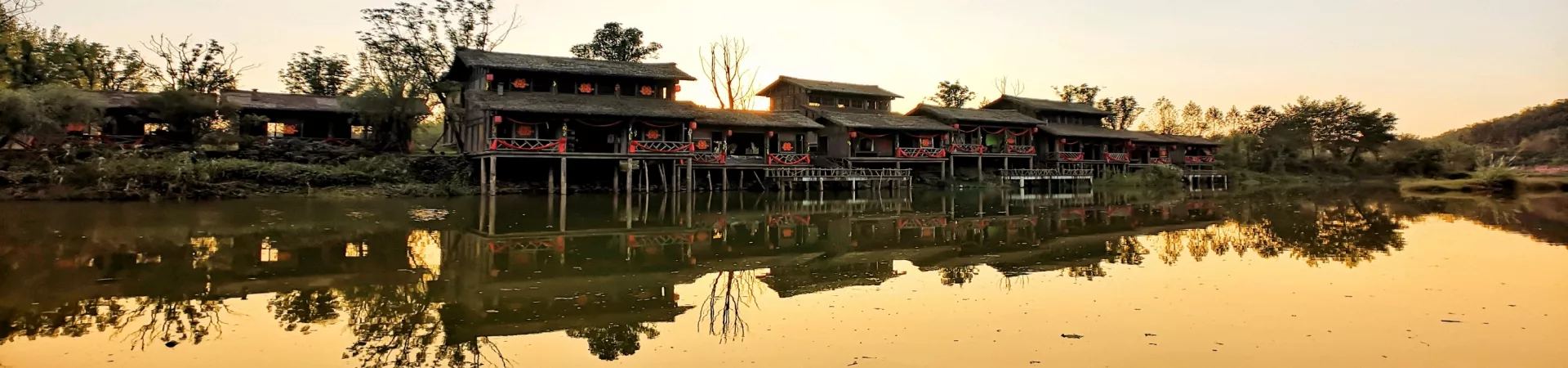
Subtitle: A Journey to the Peach Blossom Sanctuary: China's Legendary Landscape of Peace
Introduction: The Legend Comes to Life Nestled in the verdant landscapes of Changde City, Hunan Province, the Taohuayuan (Peach Blossom Spring) Scenic Area is far more than a typical tourist destination. It is the physical embodiment of one of China's most enduring and beloved literary utopias. The entire region draws its name, spirit, and layout from the timeless prose of the Eastern Jin Dynasty poet Tao Yuanming's masterpiece, "The Tale of the Peach Blossom Spring." This fable tells of a fisherman who accidentally discovers a hidden, idyllic valley cut off from the outside world, where people live in harmony, oblivious to the passage of time and the turmoil of dynastic changes. The scenic area meticulously recreates this poetic vision, offering visitors a tangible escape into a world of classical Chinese aesthetics, spiritual tranquility, and breathtaking natural beauty. Furthermore, it holds a significant place in Taoist tradition, recognized as one of the only five sites in all of China where the sacred concepts of "Dongtian" (Grotto-Heaven) and "Fudi" (Blessed Land) coexist.
Exploring the Scenic Zones: A Tapestry of Nature and Culture The vast scenic area is thoughtfully divided into several distinct zones, each offering a unique facet of the Peach Blossom Spring experience. A visit here is a journey through interconnected realms of water, mountain, forest, and ancient architecture.
1. The Qinxi River and Qingu Valley Your journey often begins with the Qinxi River, the serene waterway believed to mirror the path taken by the fisherman in the legend. A boat ride along its calm waters, flanked by lush greenery and dramatic karst formations, sets the tone for the adventure, slowly distancing you from the modern world. Disembarking leads you into Qingu Valley, a secluded area designed to represent the simple, agrarian life of the utopian villagers. Here, you can witness traditional farming methods, rustic wooden houses, and perhaps even encounter "villagers" in period costume, fully immersing you in the ancient, peaceful atmosphere of the tale.
2. The Heart of the Scenery: Taohua Mountain and Taoyuan Mountain These two mountains form the core geographical and spiritual backbone of the area. Taohua Mountain (Peach Blossom Mountain) is, as the name suggests, the centerpiece for the region's most famous natural spectacle. Its slopes are home to vast orchards, part of the "Ten-Thousand-Mu Peach Forest" that blankets the region. Hiking its trails, especially in spring, is an unforgettable experience. Taoyuan Mountain (Peach Spring Mountain) complements this with deeper cultural and religious layers. It is here that you will find the historic Taichuan Wanshou Palace, one of the four great sacred sites of ancient Chinese Taoism. This temple complex, with its ancient architecture and serene courtyards, offers a profound sense of history and spirituality, directly linking the landscape to centuries of religious practice and pilgrimage.
3. Wuliu Lake and the Ancient Town Connecting several areas is the picturesque Wuliu Lake (Five Willows Lake), named in honor of Tao Yuanming himself, who styled himself as "Mr. Five Willows." Its reflective waters and elegant bridges create perfect, photogenic vistas of the surrounding hills and pavilions. Adjacent to the lake lies the Taohuayuan Ancient Town. This is not a historical relic but a meticulously constructed living museum and cultural hub. Its Ming and Qing dynasty-style architecture houses shops selling local crafts, restaurants serving authentic Hunanese and Changde cuisine, tea houses, and inns. It serves as a perfect base for visitors, offering amenities while maintaining the ancient charm of the overall environment.
The Unmissable Spectacle: The Sea of Blossoms No description of Taohuayuan is complete without emphasizing its defining feature: the Ten-Thousand-Mu Peach Blossom Forest. This expansive, rolling landscape of peach trees transforms each year around March. During this peak season, the entire valley erupts in a breathtaking panorama of soft pink and white blossoms. The air fills with a delicate fragrance, and the view of flowers against the backdrop of green mountains and traditional rooftops is quintessentially Chinese, a scene straight out of a painting or poem. Visiting during the annual Peach Blossom Festival is highly recommended, though it is also the busiest time.
Practical Information for Visitors
1. Ticket Information * Standard Adult Ticket: 128 RMB. * Concession Ticket (64 RMB): Applies to minors aged 14-18; seniors aged 60-65 with valid ID; full-time undergraduate students and below with valid student and ID cards (including international students from Hong Kong, Macau, Taiwan, and overseas with passports and student visas). * Free Admission: Granted to seniors aged 65+; children under 14; individuals with disabilities (with disability certificate); licensed tour guides on duty (with guide card); active-duty military personnel, civilian military staff, disabled veterans, and retired military with immediate family (with valid ID and proof of relationship); national and regional-level honor recipients in moral楷模 categories (with certificate and ID); firefighters (with official work identification). * Note: All ticket information is subject to change. Please verify the latest prices and policies at the official ticket windows or website before your visit.
2. Opening Hours The scenic area is generally open from 8:30 AM to 6:00 PM, daily throughout the year. However, specific opening times for individual attractions within the park (like boat rides on Qinxi River or the last entry to certain temples) may vary. It is advisable to check the schedule upon arrival.
3. Suggested Duration To fully appreciate the main zones—including a boat ride, walks through the valleys and mountains, a visit to the Taoist temple, and some time in the ancient town—a minimum of 3 to 4 hours is required. Visitors seeking a more leisurely pace, perhaps involving a meal, detailed photography, or longer hikes, should plan for 5-6 hours or even a full day.
4. Transportation Guide The most common public access is via bus from Changde city center. Travelers can take a bus from the Changde Changnan Long-Distance Bus Station heading towards destinations like Taohuayuan, Luhua, Yangxiqiao, Shaping, Cha'anpu, Taipingpu, or Xi'an. The key is to inform the driver or conductor that you wish to alight at the Taohuayuan Scenic Area stop. The journey typically takes about an hour. For greater flexibility, hiring a private car or taxi from Changde is also a convenient option.