Moral Palace
Subtitle: A Journey into the Heart of Daoist Philosophy in Bozhou
1. Introduction: The Historical and Spiritual Nexus Nestled within the bustling streets of modern Bozhou, in present-day Anhui Province, stands a monument of profound cultural and spiritual significance: the Palace of Dao and Virtue, or Daode Zhonggong. Also reverently known as the "Ancestral Master Hall," this site is not merely an ancient architectural complex but a living testament to the enduring legacy of Laozi, the foundational philosopher of Daoism. Its location in Bozhou is historically resonant, placing it at the very crossroads of Chinese philosophical thought. The palace's existence transforms the city from a mere geographical point into a sacred destination, a place where history, legend, and spiritual pursuit converge. For any visitor interested in the roots of Chinese civilization, understanding this site offers a direct conduit to the philosophical underpinnings that have shaped East Asian culture for millennia.
2. Historical Lineage: From Antiquity to the Present Day 2.1. Foundations and Reconstructions The origins of the Daode Zhonggong stretch back to the Tang Dynasty, a golden age of Chinese culture that actively venerated Laozi, claiming him as a royal ancestor. Although initially constructed during this period, the palace as seen today primarily dates from a major reconstruction in the Ming Dynasty, under the Wanli Emperor (reigned 1572-1620). This reconstruction effort underscores the continuous imperial patronage and popular devotion Laozi received across dynasties. Historically, the Bozhou region, situated along the fertile banks of the Guo River, was a central hub for Laozi worship. During the Song Dynasty, it was one of three major temples dedicated to him, forming a sacred triad with the Shangqing Palace in Luyi, Henan (traditionally considered his birthplace), and the Xiaqing Palace in Guoyang.
2.2. Imperial Patronage and Cultural Status The site's national importance is highlighted by recorded visits from several Chinese emperors, including Emperor Taizong and Gaozong of the Tang Dynasty and Emperor Zhenzong of the Song Dynasty. Their pilgrimages were acts of profound state symbolism, linking imperial authority to Daoist wisdom and celestial mandate. Emperor Gaozong of Tang conferred upon Laozi the exalted title "Supreme Mysterious and Primordial Emperor," while Emperor Zhenzong of Song later expanded it to "Supreme Lord Lao, Emperor of Chaotic Prime and Superior Virtue." Such titles illustrate the philosopher's apotheosis into a central deity within the Chinese religious pantheon. The esteem for the site is further captured in a verse by the renowned Song Dynasty literatus and statesman Ouyang Xiu, who served as the prefect of Bozhou: "Ying and Bo gaze at each other in endless joy, / My prefecture is gifted to be an immortal's land." Today, this historical and cultural weight is formally recognized, as the Daode Zhonggong is listed as a Key Provincial Cultural Relics Protection Unit.
3. Architectural Layout and Symbolic Spaces 3.1. The Central Axis: A Path of Reverence The palace complex is organized along a traditional central axis, guiding visitors on a symbolic journey. The entrance is marked by a mountain gate (Shanmen) of three bays, inscribed with the four powerful characters "Daode Zhonggong." Passing through this gate, one enters the first main hall, which is dedicated to the worship of humanity's ancestral figures. This reflects the Daoist integration of ancient Chinese ancestor veneration into its spiritual framework. The culmination of the axis is the rear hall, the sacred heart of the complex, which enshrines Laozi. Here, a majestic statue of the sage, standing 3.1 meters tall, presides in serene contemplation, embodying the principle of the Dao, or the "Way."
3.2. The Eastern and Western Courtyards: Complementary Forces Flanking the central axis are two subsidiary courtyards, each rich in symbolic meaning. The Eastern Courtyard contains a three-bay hall dedicated to Lu Ban, the legendary patron saint of carpenters and builders. The inscription above its gate, "Purple Air Comes from the East," is a direct allusion to the famous legend that Laozi arrived in the Pass from the east, his journey heralded by auspicious purple clouds. This courtyard thus connects Laozi's wisdom to practical mastery and creation. Conversely, the Western Courtyard houses a hall for the worship of the God of Wealth. Its gate proclaims "The Black Ox Travels West," referencing the very vehicle—a black ox—on which Laozi famously departed westward, eventually composing the Daodejing. This courtyard symbolizes the application of Daoist non-action (wuwei) to prosperity and the flow of cosmic energies.
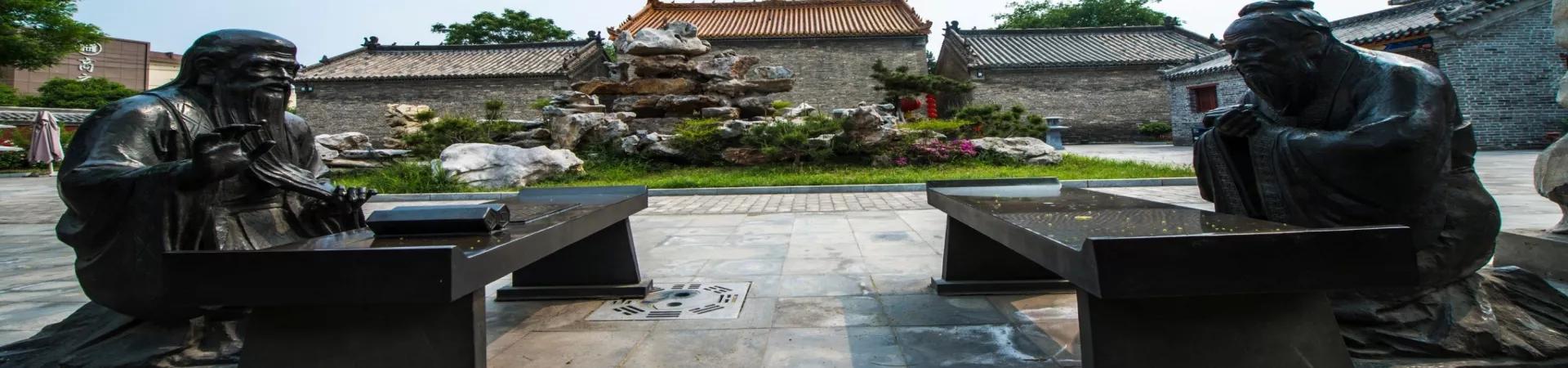
4. The Legendary Ground: Confucius and the "Inquiry on Rites Lane" Adjacent to the palace lies a narrow, unassuming lane named "Wen Li Xiang," or the "Lane of Inquiring about Rites." Local tradition steadfastly holds that this was the very spot where Confucius, the great sage of Ruism (Confucianism), traveled to seek wisdom from Laozi on the intricacies of rites and ceremonies. This legendary encounter, whether historical or mythological, is of monumental significance in Chinese intellectual history. It represents a seminal moment of dialogue between China's two greatest native philosophical traditions: the morally and socially structured world of Confucianism and the natural, spontaneous, and metaphysical perspective of Daoism. Standing in this lane, a visitor stands at a metaphorical intersection of these two mighty rivers of thought, a place where foundational questions about society, nature, and the cosmos were once passionately discussed.
5. Practical Information for Visitors 5.1. Location and Access The Daode Zhonggong is located on Laozi Hall Street (Laozi Dian Jie) in the historical center of Bozhou City. It is easily accessible by local taxi or public transportation.
5.2. Opening Hours and Admission The site is open to the public daily from 8:30 AM to 5:30 PM, with last admission at 5:00 PM. It is advisable to allocate approximately 1 to 3 hours for a thorough visit to appreciate the architecture, artifacts, and tranquil atmosphere fully. For specific and current ticket pricing, purchasing procedures, and detailed concession policies (which often apply to seniors over 70, active military personnel, and certified tour guides), it is recommended to contact the site management directly or consult with the local tourist information center prior to your visit. The contact number for inquiries is 0558-5551202.