Bozhou Museum
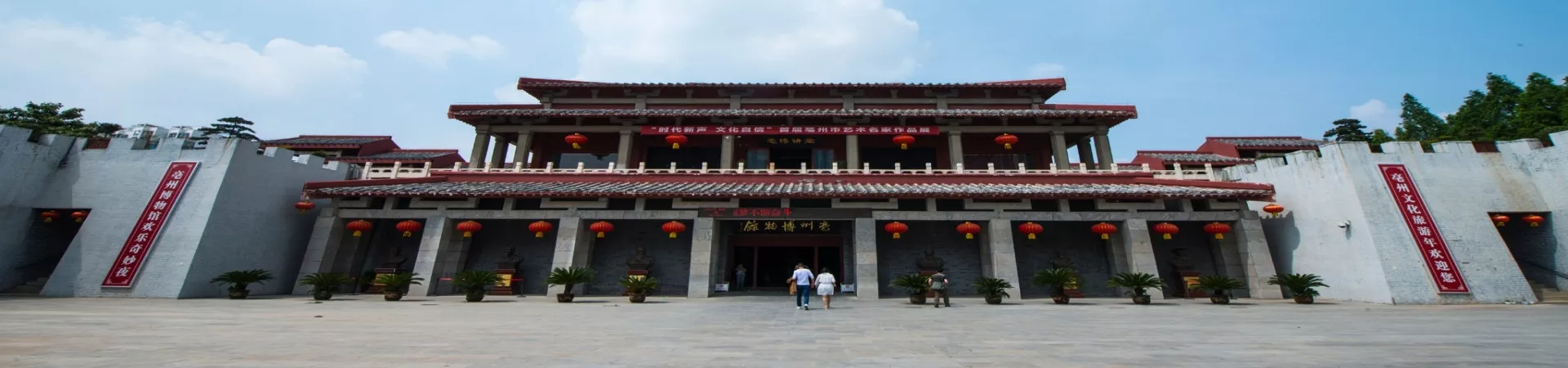
Subtitle: A Journey Through Millennia: Exploring the Cultural Heart of Anhui at Bozhou Museum
1. Introduction: A Fortress of History
Nestled within the historic city of Bozhou in Anhui Province, the Bozhou Museum stands as a monumental gateway to the past. Its distinctive architecture, modeled after a Han-dynasty fortress, immediately signals the deep historical journey that awaits within. The museum's very structure is built upon a significant cultural site—the former "Three Kingdoms Victory Palace"—a detail that layers its modern purpose with historical resonance. This transformation into a comprehensive museum was crowned in 1963 when Guo Moruo, the esteemed president of the Chinese Academy of Sciences at the time, personally inscribed its name. Encompassing a total area of 25,000 square meters, with a building footprint of 5,200 square meters, the museum dedicates 2,800 square meters to its meticulously curated indoor exhibitions. It safeguards a permanent collection of over 2,687 cultural relics, serving not merely as a repository of artifacts but as what locals proudly call the city's "name card, cultural microchip, and historical negative"—the essential record of Bozhou's soul.
2. The Core Exhibition: Traversing Five Thousand Years
The museum's intellectual and visual centerpiece is its main exhibition on the first floor, titled "Through Five Millennia: Tracing the Origins of Bozhou Culture." This ambitious narrative unfolds chronologically, guiding visitors on an immersive voyage that reveals the region's profound cultural depth and the stunning diversity of its material heritage. Comprising approximately 810 sets of carefully selected artifacts, the exhibition is divided into eight coherent sections, each a chapter in Bozhou's epic story.
2.1. Prelude and The Cradle of Civilization: The Wohe River The journey begins in the Prologue Hall, setting the stage for the exploration. It seamlessly transitions into the "Civilization of the Wohe River" section, which delves into the Neolithic foundations of the region. The Wohe River basin is presented as the fertile cradle where Bozhou's earliest societies took root, with artifacts illustrating the dawn of agriculture, pottery, and settled life.
2.2. Dynastic Capitals and Philosophical Wellsprings The narrative then ascends to the era of high antiquity with "Shang Tang's Capital: Bo." This segment is crucial, showcasing Bozhou's claim as one of the earliest capitals in Chinese history during the Shang Dynasty. Archaeological evidence here solidifies the city's status as a political heartland over three thousand years ago. Following this, "The Sacred Origin of Daoism" explores Bozhou's unparalleled spiritual significance. As the birthplace of the seminal philosopher Laozi, the founder of Daoism, the region is presented as a fountainhead of one of the world's most influential schools of thought. Relics and explanations connect the local landscape to the development of Daoist philosophy and its enduring legacy.
2.3. The Age of Imperial Splendor The museum vividly brings to life the "Han and Wei Dynasties' Character," a golden age for Bozhou. This was the period of the renowned Cao family, with Cao Cao, his sons Cao Pi and Cao Zhi, being towering figures in politics, military strategy, and most famously, literature. The exhibition highlights the "Jian'an Style" of poetry that flourished here, alongside artifacts reflecting the military, administrative, and luxurious daily life of this powerful epoch. The subsequent section, "A Preeminent Prefecture Under Heaven," illustrates how Bozhou's importance continued through subsequent dynasties like the Tang and Song. It details its role as a strategic commandery and a thriving economic center, demonstrating sustained national significance beyond its early dynastic glory.
2.4. From Mercantile Hubs to Modernity Shifting focus to social and economic history, "The Marketplaces of Bozhou Merchants" recreates the vibrant commercial culture that characterized the city, especially during the Ming and Qing dynasties. Exhibits might include currency, trade tools, and reconstructions of shop fronts, evoking the bustling streets where local merchants drove regional prosperity. Finally, the exhibition brings the story into the recent past and present with "Modern and Contemporary Bozhou." This section connects the threads of its illustrious history to the city's development in the 19th and 20th centuries, showing how its cultural identity has evolved and persisted into the modern era.
3. Practical Visitor Information
3.1. Location and Transportation The Bozhou Museum is a key cultural destination within the city. Visitors can conveniently reach it by public bus. Taking Bus No. 2 or No. 5 and alighting at either the "Cao Cao Memorial Hall" or "Sancao Road Intersection" stop will place you within easy walking distance of the museum.
3.2. Admission and Operating Hours In line with its mission to provide public access to culture and history, the museum offers free admission to all visitors. The museum's opening hours are as follows: * Tuesday to Sunday: 09:00 - 17:00 (Last entry at 16:30). * Monday: Open all day (specific hours typically align with the regular schedule, but it is advisable to confirm locally for any seasonal variations). * These hours apply throughout the year, from January 1st to December 31st.
3.3. Contact Information For any inquiries or to confirm specific details before your visit, you can contact the museum directly at +86-558-5552493.