Red Army Stele Forest
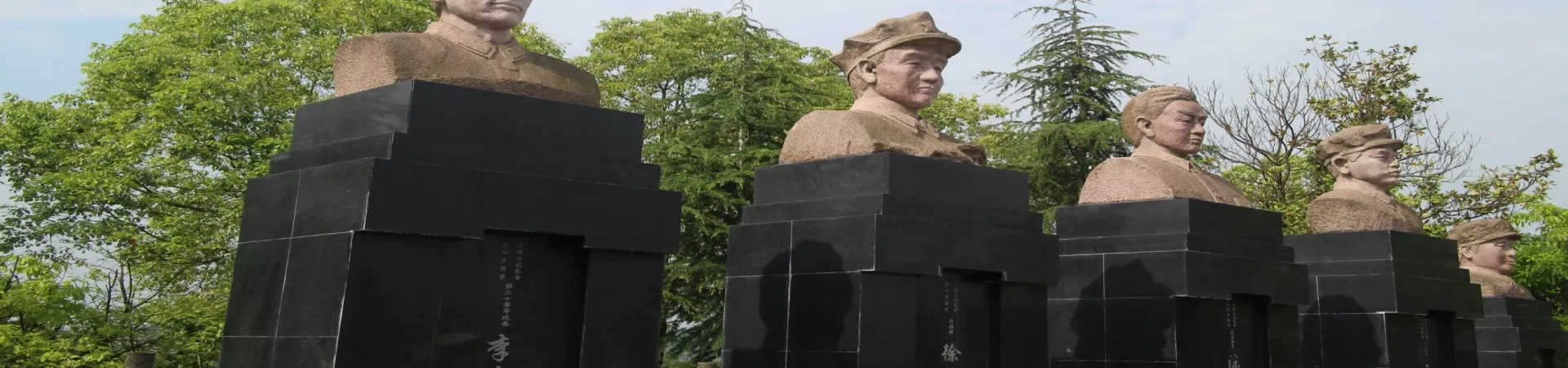
Subtitle: Echoes of Revolution: Exploring the Red Army Stele Forest in Bazhong, Sichuan
1. Introduction: A Living Monument in the Red Heartland
Nestled in the deep green mountains of northeastern Sichuan, the city of Bazhong holds a profound place in modern Chinese history. It was here, in the rugged terrain that defined the Sichuan-Shaanxi border area, that one of the largest Soviet bases of the Chinese Workers' and Peasants' Red Army was established and fiercely defended. The Red Army Stele Forest (红军碑林, Hóngjūn Bēilín) is not merely a collection of stone carvings; it is the spiritual core of this "Red Capital," a vast open-air museum where history is etched permanently into rock and memory. More than 13,000 stone inscriptions, scattered across the region but centrally curated and protected within this site, form the largest and most concentrated collection of Red Army cultural relics in China. This forest of steles serves as a silent, powerful chorus, giving permanent voice to the ideals, struggles, and daily realities of a revolutionary era that shaped the nation.
2. Historical Context: The Sichuan-Shaanxi Soviet and Its Legacy
2.1 The Crucible of Revolution To understand the significance of the stele forest, one must journey back to the early 1930s. Following the strategic shifts during the Long March, the Fourth Front Army of the Red Army, led by Xu Xiangqian and others, established the Sichuan-Shaanxi Revolutionary Base Area. Bazhong became its political, military, and economic center. For nearly two years, this base area was a vital stronghold, resisting encirclement campaigns and implementing land reform.
2.2 Propaganda Carved in Stone In an era of limited media, the Red Army became a master of grassroots communication. Walls, cliffs, and standalone stones became their canvas. From 1933 to 1935, soldiers and political workers inscribed thousands of slogans, policies, and declarations directly onto the landscape. Their purposes were multifaceted: * Mobilization: Calling the local populace to join the army and support the revolution. * Policy Announcement: Publicizing the Ten-Point Land Law and other core policies of the Soviet government. * Ideological Education: Promoting socialist ideals and defining the struggle against the Kuomintang and local warlords. * Military Morale: Boosting the spirit of troops and warning against desertion. * Practical Information: Marking roads, issuing notices, and even inscribing literacy primers.
3. The Stele Forest Collection: A Taxonomy of Stone Inscriptions
The preserved inscriptions are systematically categorized, offering a multidimensional view of revolutionary life.
3.1 Slogans and Mobilization This is the most voluminous category. Powerful, concise phrases like "Carry the Revolution Through to the End!" (革命到底), "Expand the Red Army!" (扩大红军), and "Down with the Local Tyrants and Divide the Land!" (打倒土豪分田地) were carved in large, bold characters. They were designed for immediate impact, transforming the physical environment into a space charged with revolutionary fervor.
3.2 Decrees, Manifestos, and Legal Documents These are the most historically significant steles. Full-text carvings of documents such as the "Ten-Point Land Law of the Chinese Soviet Republic" and the "Manifesto of the Central Committee of the Chinese Communist Party on the War against Japanese Imperialism" served as permanent, public records. They functioned as the constitutional bedrock of the Soviet administration, accessible to all in an era of low literacy, where public reading sessions would be held beside them.
3.3 Tombstones and Memorials Sobering and poignant, these steles commemorate fallen soldiers, commanders, and local martyrs. They range from simple markers for unknown soldiers to elaborate monuments for figures like Wu Hanzhang, a senior political commissar. They transform the site from a political platform into a hall of remembrance, honoring individual sacrifice within the collective movement.
3.4 Literacy, Education, and Daily Life Perhaps the most humanizing category includes inscriptions used as teaching tools. "Literacy Grids" (识字牌), carved with basic characters, were used to educate soldiers and peasants. Notices about hygiene, notices for meetings, and even verses of revolutionary poetry reveal the day-to-day efforts to build a new society and culture amidst warfare.
4. Artistic and Cultural Significance
4.1 Calligraphy on a Grand Scale The stele forest is an unparalleled exhibition of revolutionary-era calligraphy. The script is predominantly bold, straightforward, and easily legible—a reflection of its utilitarian and propagandistic purpose. The carving techniques vary from precise, deep engravings to quicker, gestural chiseling, often mirroring the urgency of the moment. The characters themselves, frozen in stone, possess a raw, powerful aesthetic that differs markedly from the refined traditions of classical Chinese stele art.
4.2 Integration with the Bazhong Landscape The inscriptions were never meant to be viewed in isolation. They are intrinsically linked to their locations: on cliff faces overlooking strategic paths, on boulders in village squares, on the walls of former government offices (like the one in Tongjiang County). The Bazhong Global Geopark provides the dramatic geological stage—the sandstone cliffs and karst formations—upon which this historical drama was literally inscribed. The natural and historical are inextricably fused.
5. Visiting the Stele Forest: A Reflective Experience
5.1 The Main Preservation and Exhibition Area The core of the Stele Forest is now a meticulously organized preservation zone. Key monumental steles, such as the Land Law stele, are housed in protective pavilions. A museum provides historical context, displaying artifacts like weapons, uniforms, and documents that complement the stone narratives. The path through the forest is designed for contemplation, allowing visitors to engage with each stele at close range.
5.2 Connecting to the Broader Red Tourism Circuit A visit to the Stele Forest is the centerpiece of a broader historical journey through Bazhong. The site is intrinsically connected to other key locations: * Former Sites of the Sichuan-Shaanxi Soviet Government: The network of headquarters, hospitals, and arsenals scattered in the region. * Wangping Town and Enyang Ancient Town: Well-preserved ancient towns that served as critical hubs for the Red Army, where inscriptions blend with centuries-old architecture. * Revolutionary Martyrs' Cemetery: A solemn space for paying respects, completing the narrative arc from struggle to sacrifice to commemoration.
Walking through the Red Army Stele Forest is an encounter with text as a revolutionary act. The cold stone carries the heat of a transformative period. Each carved character is a direct link to the voices of the past—the political commissar drafting a slogan, the soldier learning to write his name, the local peasant reading a new land decree. It stands as a unique testament to how a movement used landscape itself as a tool for ideology, mobilization, and memory, leaving behind not just a history book in stone, but the very soul of a revolutionary base area preserved for generations to witness.