Yuan Lin
Subtitle: A Duality in Stone: Exploring the Architectural and Historical Paradox of Yuan Lin, the Tomb of Yuan Shikai
1. Introduction: A Monument to a Contradictory Legacy Nestled in Anyang, a city steeped in the earliest foundations of Chinese civilization, lies a sepulchral anomaly known as Yuan Lin. This is the final resting place of Yuan Shikai, one of modern China's most pivotal and controversial figures. More than just a tomb, Yuan Lin stands as a profound architectural metaphor in brick, stone, and marble. Its very design, an intentional and jarring fusion of traditional Chinese imperial grandeur and modern Western presidential austerity, physically manifests the complex and tumultuous identity of the man it entombs. For visitors, a journey here is not merely a sightseeing excursion but an immersive encounter with a tangible piece of early 20th-century history, where architectural styles clash and coalesce, telling a story of ambition, transition, and profound contradiction.
2. Architectural Synthesis: Where East Meets West The paramount characteristic of Yuan Lin is its deliberate and stark architectural eclecticism. The tomb complex is cleaved into two distinct stylistic halves, creating a visually arresting and intellectually stimulating landscape.
2.1. The Eastern Approach: Imperial Pretensions The front section of the tomb complex, leading to the main sacrificial hall, is constructed in the solemn and majestic style reserved for the mausoleums of Qing Dynasty emperors. Visitors proceed along a spirit way lined with stone statues of civil and military officials, mythical beasts, and horses, following a traditional axial layout that emphasizes hierarchy and imperial authority. The main gate and the hall for offerings (Xiang Hall) feature classic Chinese architectural elements: sweeping roofs, intricate dougong bracketing systems, and the use of vibrant colors. This portion of Yuan Lin unmistakably proclaims Yuan Shikai's aspirations and his brief, ill-fated reign as the Hongxian Emperor.
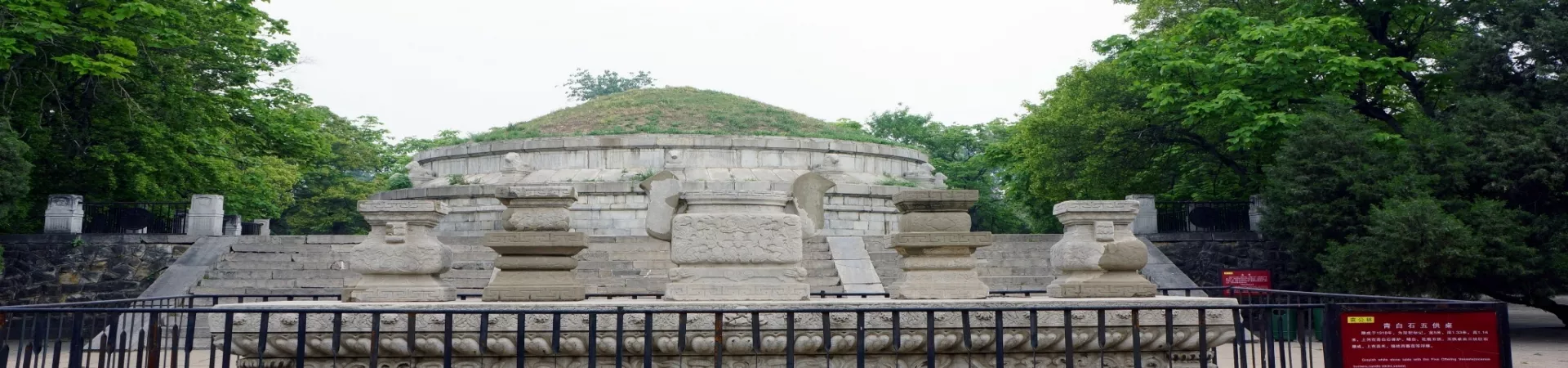
2.2. The Western Resting Place: Presidential Ambiance In a dramatic stylistic rupture, the actual tomb mound at the rear of the complex abandons Chinese tradition entirely. Here, the design is a clear imitation of the neoclassical, dome-shaped presidential tombs found in the West, most notably reminiscent of the U.S. Grant Tomb in New York City. Constructed from solid reinforced concrete and faced with granite, this hemispherical mound is surrounded by squat, solid walls and exudes a sense of heavy, austere permanence. This architectural choice is widely interpreted as an attempt to legitimize his presidency of the Republic of China and to align his image with that of modern Western statesmen.
3. Artistic and Historical Highlights Beyond the grand dichotomy, Yuan Lin houses specific features of exceptional artistic merit and historical significance.
3.1. The Majestic Spirit Wall (Zhao Bi) The visit begins at the southernmost point with what is arguably the site's single most magnificent artifact: the colossal Spirit Wall. This screen wall, built in the traditional Chinese hard mountain roof style and adorned with glazed green tiles, is the largest and most exquisitely decorated of its kind surviving in China. The inner side of the wall is covered with breathtakingly detailed brick carvings featuring auspicious symbols, floral patterns, and other intricate motifs. It serves as a masterful prelude, showcasing peak traditional craftsmanship before introducing the complex's later stylistic divergences.
3.2. The Stone Figures on the Spirit Way The procession of stone statues along the sacred path is a standard feature of imperial tombs, but here it carries particular irony. The figures, frozen in their dutiful poses, seem to guard a legacy that was both imperial and republican, highlighting the unresolved tensions of the era.
3.3. The Stele Pavilion and Sacrificial Hall The Stele Pavilion houses a large stone tortoise bearing a stele, another imperial convention. The subsequent Sacrificial Hall, where rituals were performed, is the architectural centerpiece of the traditional section. Its interior, now often used as an exhibition space, provides context through historical photographs and documents detailing Yuan Shikai's life, his role in ending the Qing Dynasty, his presidency, and his monarchical misadventure.
4. Practical Visitor Information To fully appreciate the layers of history and architecture, careful planning is recommended.
4.1. Location and Transportation Yuan Lin is located in the Beiguan District of Anyang, Henan Province. The most straightforward public transportation method is to take Anyang city bus routes 8 or 23 and alight at the dedicated "Yuan Lin" station. The site is clearly marked and accessible.
4.2. Admission and Operational Hours * Ticket Fee: The entrance ticket is priced at 35 RMB. * Guided Tours: A dedicated讲解费 (explanation fee) of 40 RMB is highly advisable. The nuanced history and architectural symbolism are greatly enhanced by a knowledgeable guide. Alternatively, visitors may choose to listen in on guided tours for organized groups. * Opening Hours: * Summer Schedule (June 1 - August 31): 08:30 - 18:00, with last admission at 17:30. * Winter Schedule (December 1 - February 28): 08:30 - 17:30, with last admission at 17:00. * Hours for the shoulder seasons typically follow the winter schedule.
4.3. Suggested Duration and Tips A comprehensive visit typically requires 1.5 to 3 hours, allowing time to contemplate the architecture, explore the exhibitions, and reflect on the historical narrative. Beyond the visual experience, visitors are encouraged to ponder the site as a physical dialogue between tradition and modernity, monarchy and republicanism—a dialogue that remains central to understanding China's turbulent path into the modern world. The tomb, in its silent, hybrid grandeur, offers no easy answers but poses enduring questions about power, legacy, and how a nation chooses to remember its most contentious chapters.